2. Rhodostemonodaphne velutina

Rhodostemonodaphne velutina (Mez) Madriñán, comb. nov.

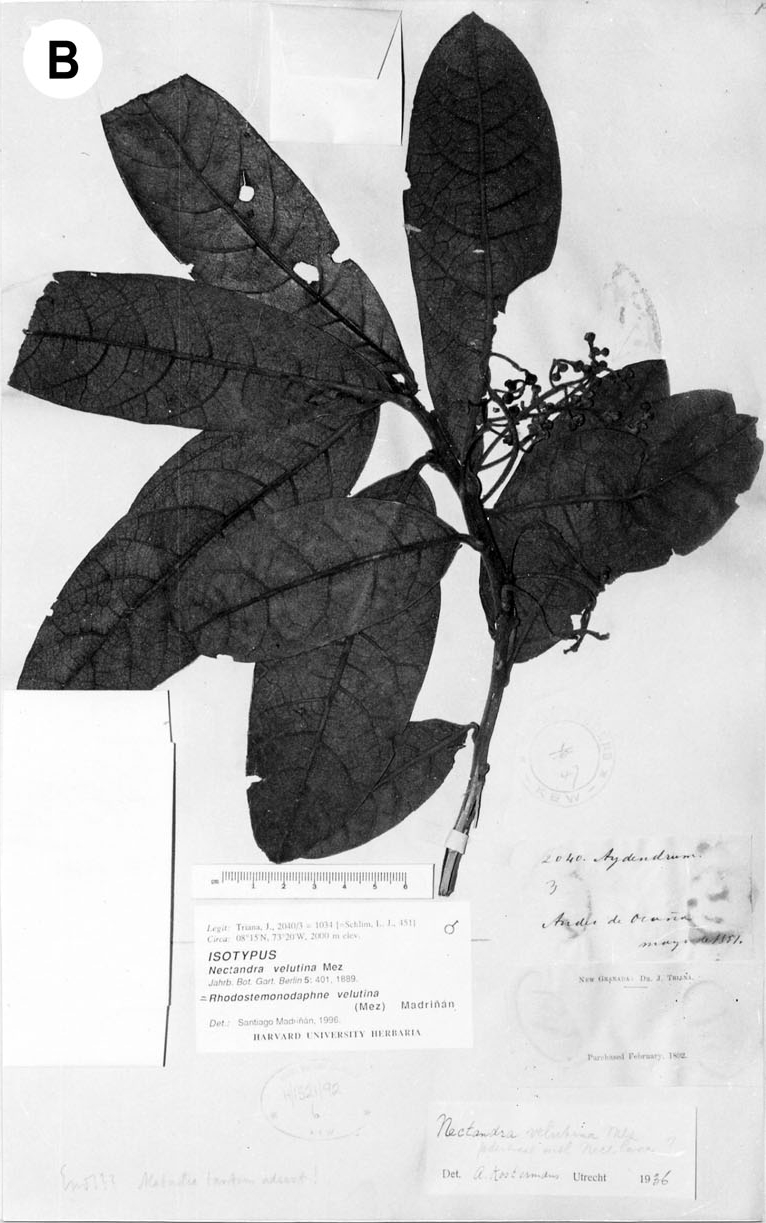
Nectandra velutina Mez, Jahrb. Konigl.Königl. Bot. Gart. Berlin 5: 401. 1889. Type. Colombia. Norte de Santander: Ocaña, Andes de Ocaña, May 1851 (stam. fl), Triana 2040/3 = 1034 [= Schlim, L. J. No.451] (holotype, P; isotypes, B [frag. ex P], COL n.v., K).

Description

Trees: branching unknown; twigs terete, ca. 6 mm diam.; epidermis brownish, barely visible due to indument cover; terminal bud plump, ca. 6 X 4 mm; cataphylls caducous; indument velutinous, persisting for at least two flushes, the hairs dense, up to 1 mm long, straight to curved, erect, yellowish. Leaves: petioles robust, 1–1.5 cm X 3–4.5 mm, adaxially flattened; blades coriaceous, flat, elliptic, 10–21 X 5–8 cm; base obtuse to rounded, 80–110°; apex obtuse, 70–100°; margin flatmargin recurved at base; primary vein above slightly raised, below prominent; secondary veins 7–10 pairs, equidistant, weakly brochidodromous, above flat, below raised, diverging at 65–70°, evenly arching (forked), chordal angle 45°, angle, the angle uniform along blade length; tertiary veins above flat to slightly impressed, below slightly raised, random-reticulate; higher order veins above inconspicuous, below slightly raised; surface above greenish to reddish-brown, below reddish-brown; indument above puberulous, the veins tomentose, caducous by next flush, below velutinous, the hairs dense, up to 1 mm long, straight to curved, erect, golden to reddish-brown, denser on the veins, persisting for at least two flushes. Staminate inflorescences: basitonic, pendulous, peduncles 5–11 cm long, hypopodiathe hypopodia 3.5–6 cm X ca. 2.5 mm, branch orders 3(–4), second-order , the second-order branches 4, dispersed, lowest branch up to 2 cm long, color and indument of all axes as on twigs, epidermis drying black; bracts and bracteoles caducous (not seen). Staminate flowers: pedicels ca. 6 X 1 mm, the diameter gradually increasing apically; receptacle obconical, ca. 1.5 X 4.5 mm; tepals coriaceous, obovate, ca. 2.8 X 3 mm, at anthesis erect to spreading?, black, adaxially puberulous to tomentose; stamens of whorls I and II sessile, chubby, anther , the antherssessile, chubby trapezoid to ovate, ca. 1.2 X 1 mm, glabrous, locelli, the locelli 4, apical, in a shallow arch, introrse, glands, the glands absent; whorl III columnar, ca. 1.2 X 0.8 mm, glabrous, anther , the antherstrapezoid, locelli, the locelli 4, upperthe upper pair latrorse, lowerthe lower pair extrorse, glands, the glands absent (? or fused in a ring); whorl IV absent; all stamens reddish-black; pistillode absent. Pistillate flowers and fruits unknown.
Field notes

Unavailable.

Distribution

Known only from the type collected on the Eastern cCordillera Oriental of the Andes in northern Colombia near the town of Ocaña; growing in cloud forest at ca. 2000 m elev.  The flowering collection was made in May towards the beginning of the rainy season.

Additional specimens examined


Discussion

Rhodostemonodaphne velutina is clearly most closely related to Rh.R. laxa, a cloud forest species of the Central cordillera Central of the Andes.  The two species are very similar in habit, leaf size and shape, and flower morphology.  The most striking difference is the dense velutinous indument of Rh.R. velutina covering all plant parts, including inflorescence axes and flowers.  Further differences are its leaf margins recurved at the base, and an anatomical character–-tabular upper epidermis (in Rh.R. laxa it is isodiametric) with a thicker cuticle.  The flowering times of the two species are different, Rh.R. laxa flowering November–February, Rh.R. velutina in May.

Mez (1889) considered Nectandra velutina a separate species from N. laxa, on the basis of the different indument.  Rohwer (1986) proposed it as a likely synonym.  Even though we know nothing about the variation of indument character for Rh.R. velutina, none of the 11 known specimens of Rh.R. laxa show this extreme velutinous indument.  I Colombia tThe Cordillera Oriental and the Cordillera Central Eastern and Central Cordilleras of the Andes are separated by a wide, deep valley (the Magdalena river valley).  The species may be found on the unexplored mountaintops of the Serranía de San Lucas–-a low-lying mountain range between the Eastern and Central Cordilleras Oriental and the Cordillera Central; if so, continuity between the two known ranges would be more likely.  There are no collections of this species to in the south of the country where the two Cordilleras meet–-although far from completely known, the Colombian montane flora is one of the best collected in the country.  It is highly unlikely that these populations are reproductively linked, and this separation may be quite old–-the Andean uplift started in the Tertiary more than 10 m.y.b.p.–-unless they are the result of a recent event of long distance dispersal.  Until more collections are available, I prefer to keep them as separate species.

Contact | Updated 28.07.2005 | ©2005 Santiago Madriñán