Description
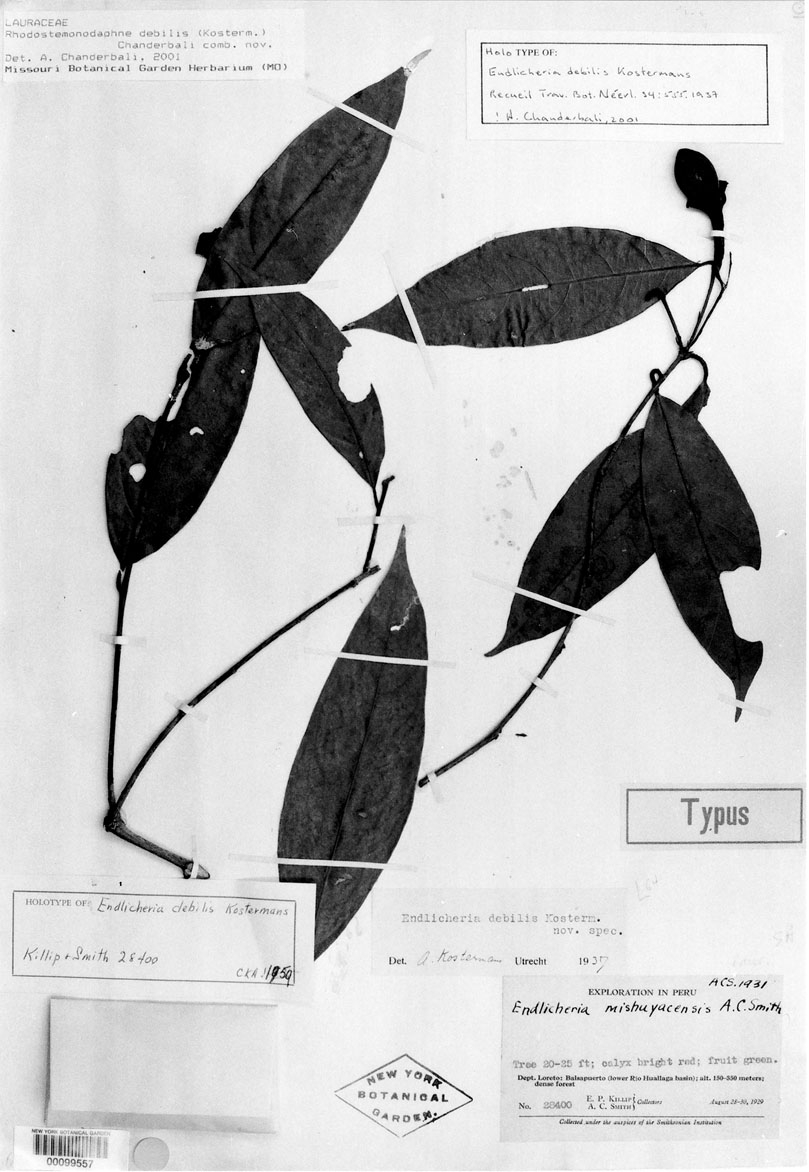
Shrub to tree: branches basitonic, in axils of cataphylls; twigs terete, 1–2 mm diam.; epidermis brownish; terminal bud unknown; cataphylls persisting on current flush, up to 4 mm long; indument puberulous, caducous after one flush, the hairs sparse, up to 1 mm long, straight to curved, appressed ascending, brownish. Leaves: petioles slender, 1–1.5 cm X 1 mm, terete; blades chartaceous, flat, narrowly elliptic, 9–15 X 2.5–4.5 cm; base acute, 70–100°; apex acute, 50–70°, ultimately acuminate for up to 1.5 cm; margin plane; primary vein above and below raised; secondary veins 5–8 pairs, equidistant, brochidodromous, above slightly raised, below raised, diverging at ca. 60°, evenly arching, chordal angle ca. 30°, the angle uniform along blade length; tertiary veins above and below slightly raised, random-reticulate to scalariform; higher order veins above and below slightly raised; surface above and below brown, the veins similar; indument above absent, the primary vein puberulous at base, below puberulous, the hairs sparse, up to 0.3 mm long, straight to curved, appressed, brownish, somewhat denser on the veins, persisting for at least two flushes. Staminate plant unknown. Pistillate inflorescence: basitonic, erect?, peduncle 4 cm long, hypopodium ca. 4 cm X 2 mm, branching unknown, color and indument as on twigs; bracts not seen. Pistillate flowers unknown. Fruits: pedicels 25 X 5 mm, abruptly enlarging to form the cupule; cupule hemispherical, 18 X 13 mm, smooth, the margin undulate, tepals persisting; berry elliptic, 28 X 18 mm.