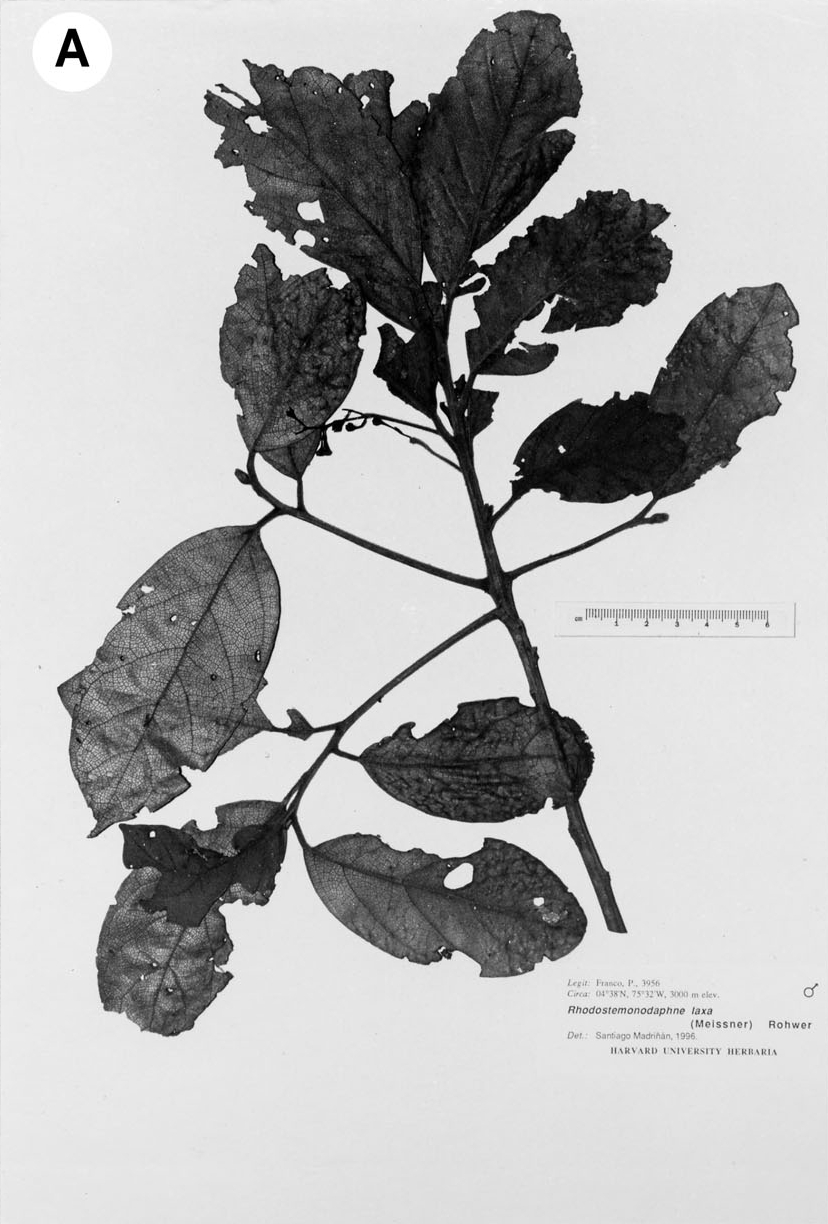
1. Rhodostemonodaphne laxa

Rhodostemonodaphne laxa (Meissner) Rohwer

Mitt. Inst. Allg. Bot. Hamb. 20: 83. 1986. Synandrodaphne laxa Meissner, in A. L. de Candolle, Prodr. 15(1): 176. 1864. Nectandra laxa (Meissner) Mez, Jahrb. Königl. Bot. Gart. Berlin 5: 400. 1889. Type. Colombia. Quindío: Quindío Pass, Nov 1827 (stam. fl), Goudot s.n. (holotype, K [photo NY neg. 8502]; isotypes, FI-W n.v., G [frags. ex FI-W et P], P).

Description

Trees: branches basitonic, in axils of cataphylls or basal foliage leaves, often pseudo-verticillate; twigs angular, soon becoming terete, 3–6 mm diam.; epidermis brownish to black, barely visible due to indument cover; terminal bud plump, 3–7 X 2–3 mm; cataphylls caducous; indument pubescent, persisting for at least two flushes, the hairs dense, up to 0.3(–0.9) mm long, straight to curved, erect, yellowish. Leaves: petioles robust, 0.5–1.3 cm X 1–3 mm, adaxially flattened; blades chartaceous, flat, narrowly (broadly) elliptic, (5–)10–14(–18) X (2–)3–5(–7) cm; base acute to obtuse, ca. 100°; apex acute, 70–120°, ultimately acuminate for up to 0.5 cm; margin flatmargin plane; primary vein above slightly raised, below prominent; secondary veins (6–)7(–9) pairs, equidistant, eucamptodromous, above slightly raised, below prominent, diverging at ca. 70°, straight to evenly arching (forked), chordal angle 40–50°, angle, the angle uniform along blade length; tertiary veins above and below raised, random-reticulate; higher order veins above and below slightly raised; surface above shiny yellowish-brown in young leaves, opaque brown in older leaves, the veins slightly lighter, below dull yellowish-brown in young leaves, faintly reddish-brown in older leaves, the veins lighter; indument above puberulous to glabrousabsent, primary , the primary and secondary veins tomentose, caducous by next flush to persisting for at least two flushes, below puberulous to velutinous, the hairs dense to sparse, up to 1 mm long, straight to curved, erect, yellowish, denser on the veins, persisting for at least two flushes. Staminate inflorescences: along whole length of flush, pendulous, peduncles 3–11 cm long, hypopodiathe hypopodia 2–6 cm X 1–1.5 mm, branch orders 4, the second-order branches 4–7, dispersed, lowest branch up to 1.5(–4) cm long, color and indument of all axes as on twigs; bracts and bracteoles caducous (not seen). Staminate flowers: pedicels ca. 5.6 X 1.2 mm, the diameter gradually increasing apically; receptacle obconical, ca. 3.2 X 3.5 mm; tepals coriaceous, ovate, ca. 5 X 4 mm, at anthesis erect to spreading, black, adaxially glabrous; stamens of whorls I and II sessile, chubby, anther , the antherssessile, chubby, trapezoid, ca. 1.4 X 1.2 mm, with a few hairs at base, locelli, the locelli 4, apical, in a shallow arch, introrse, glands, the glands absent; whorl III columnar, ca. 1.6 X 0.8 mm, with a few hairs at base, locelli, the locelli 4, upperthe upper pair latrorse, lowerthe lower pair extrorse, glands, the glands fused, forming a continuous ring protruding between the anthers of the outer whorls; whorl IV absent; all stamens blackish; pistillode filiform, ca. 1.7 X 1 mm, glabrous. Pistillate flowers: pistil ca. 3 X 1.5 mm; ovary ovoid to globose, ca. 1.5 mm long, glabrous. Fruits: pedicels up to 45 X 5 mm, gradually enlarging to form the cupule; cupule hemispherical, up to 7 X 19 mm, smooth, margin, the margin undulate, tepals persisting; berry elliptic, up to 35 X 21 mm.
Field notes

Trees up to 8 m tall and 21 cm diam.; wood aromatic (tangerine odor); leaves below bluish-green. Receptacle yellowish-green; tepals cream; stamens/staminodes cream. Cupule yellow to reddish.

Distribution (Figure 7)

Along Cordillera Central Cordillera of Colombia (N Andes) from Quindío (E slope) to Antioquia; growing in upper-montane cloud forest, at 2000–3010 m elev.  Flowering October–February during the dry season.  Immature fruits have been collected in March and found ripe by the new flowering season.

Additional specimens examined

COLOMBIA. Antioquia: Medellín-Rionegro rd., below the summit of Santa Elena, 2 Apr 1949 (fr), Barkley et al. 389 (NY, US); San Pedro (pist. imm. fr), Bro. Daniel 1439 (GH); Mar 1938 (pist. imm. fr), Bro. Tomas 163 (US). Quindío: Salento, La Cocora, Estación La Montaña, 28 Sep 1992 (st), Betancur et al. 3756 (COL, GH); Calarcá, Quindío Pass, west slope, highway above Calarcá, 22 Nov 1944 (pist. fl, fr), Fosberg 22333 (US); Salento, Estación Navarco, 24 Sep 1992 (stam. fl), Franco et al. 3956 (COL, GH, MO); Salento, La Cocora, Estación La Montaña, 28 Sep 1992 (st), 4013 (COL, GH); Salento, Estación Navarco, 23 Sep 1992 (stam. fl), Rangel et al. 9008 (COL, GH, MO); (st), Rangel et al. 9051 (COL, GH); Salento, Acaime, Jul 1993 (fr), Vargas et al. 1053 (MO).

Discussion

Rhodostemonodaphne laxa can be characterized by its yellow tomentose indument persisting on most parts of the plant (except for the inflorescences and flowers which are glabrous), leaves drying light olive-green, few-flowered, lax inflorescences, and fleshy, trumpet-shaped flowers.

The specimens from Antioquia have larger leaves than those of Quindío.  Although no collections have been made between these two areas, it is presumed that the species can be found in the intervening departments of Risaralda and Caldas.

Rhodostemonodaphne laxa is most closely related to R. velutina from which it differs primarily by the denser indument (see discussion under the latter).  Rhodostemonodaphne frontinensis may also be closely related.  It differs vegetatively in the size and shape of the leaves, those of R. frontinensis being broadly elliptic to obovate.

Specimens of this species were repeatedly misidentified as Ocotea declinata (Meissner) Mez by C. K. Allen.  Ocotea declinata (=O. deflexa Rohwer, 1986), a species from Bahia, is indeed vegetatively very similar, although I have only seen photographs only of this species.  Nevertheless, its inflorescences with their persisting bracts are very different from those of R. laxa.
Contact | Updated 29.07.2005 | ©2005 Santiago Madriñán