14. Rhodostemonodaphne licanioides
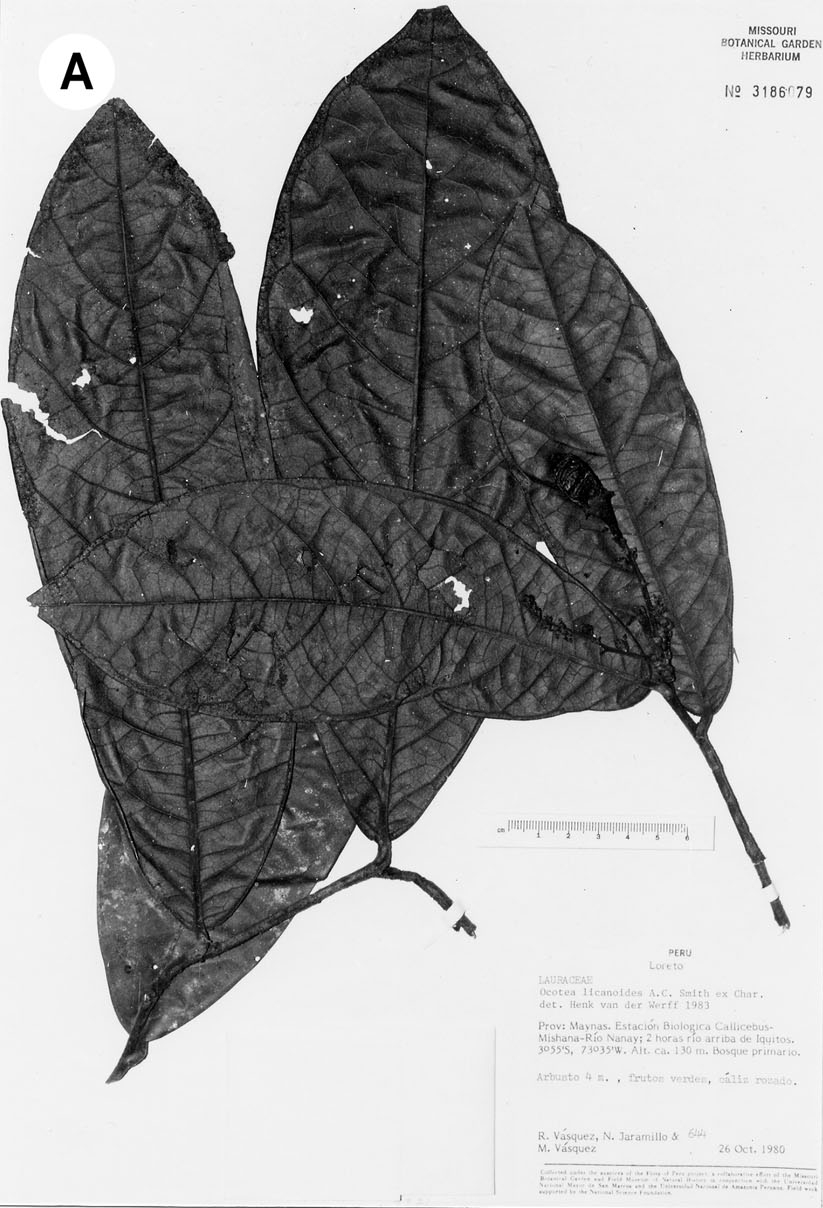
Rhodostemonodaphne licanioides (A. C. Smith) Madriñán, comb. nov.
Ocotea licanioides A. C. Smith, Bull. Torrey Club 58: 107. 1931. Type. Peru. Loreto: Mishuyacu, near Iquitos, May 1930 (stam. fl), Klug 1506 (holotype, NY; isotype US).
Endlicheria loretensis O. C. Schmidt, Repert. Spec. Nov. Regni Veg. 31: 178. 1933. Type. Peru. Loreto: Mishuyacu, near Iquitos, Apr 1930 (stam. fl), Klug 1258 (holotype, F n.v. [photos: B neg. 7712; G neg. no.?]; isotype, B [frag. ex F], G [frag. ex F], NY).
Local name. Muena (= moena) negra.
Description
Shrubs to scandent shrubs: with long, slender and sparsely branched shoots; branches basitonic, in axils of cataphylls or foliage leaves; twigs terete, 3–4 mm diam.; epidermis brownish, barely visible due to indument cover; terminal bud plump, ca. 6 X 3 mm; cataphylls persisting on current flush (and for at least three flushes), up to 6 mm long; indument pubescent, persisting for at least two flushes, the hairs dense, up to 0.8 mm long, straight, erect, brownish. Leaves: petioles robust, 0.5–1.5 cm X 0.3–0.5 mm, terete; blades coriaceous to chartaceous, flat to bullate, elliptic, 15–32 X 7–13 cm; base obtuse to rounded (almost cordate), (80–)120–140(–180)°; apex obtuse to rounded, (70–)100–140°, acuminate for up to 3 cm; margin plane to recurved; primary vein above raised, below prominent; secondary veins (7–)9–11(–14) pairs, equidistant to closer together towards the apex, brochidodromous, above impressed, below raised, diverging at 55–65°, evenly arching, chordal angle ca. 30°, lowest pair more obtuse than rest; tertiary veins above flat, below slightly raised, random-reticulate; higher order veins above inconspicuous, below slightly raised; surface above shiny brown, below olive-green to brown, the veins lighter; indument above absent, the primary vein basally tomentose, below tomentose to pubescent, the hairs sparse, up to 1 mm long, straight, erect, yellowish-brown, denser on the veins, persisting for at least two flushes. Staminate inflorescences: basitonic, erect?, peduncles 5–19 cm long, the hypopodia 1–8 cm X ca. 1 mm, branch orders 4, the second-order branches up to 14, dispersed, lowest branch up to 0.5–3.5 cm long, color and indument of all axes as on twigs; bracts persistent, up to 4 mm long, adaxially glabrous; bracteoles persistent, up to 2 mm long, adaxially glabrous. Staminate flowers: pedicels ca. 2.5 X 0.7 mm, the diameter even throughout; receptacle obconical, ca. 0.8 X 1.8 mm; tepals membranaceous, elliptic, ca. 1.6 X 1.3 mm, at anthesis spreading, reddish, adaxially glabrous; stamens of whorls I and II spathulate, laminar, the anthers oblong, ca. 0.8 X 0.8 mm, glabrous, the locelli 4, in two almost superposed pairs, introrse, the glands absent; whorl III columnar, ca. 1.4 X 0.5 mm, with a few hairs at base, the anthers oblong, the locelli 4, the upper pair latrorse, the lower pair extrorse, the glands globose, ca. 0.8 mm diam.; whorl IV absent; all stamens reddish; pistillode absent. Pistillate flowers: pistil ca. 1.6 X 0.6 mm; ovary ovoid, ca. 0.8 mm long, glabrous. Fruits: pedicels up to 10 X 3 mm, often thickening well below the bracteoles, gradually enlarging to form the cupule; cupule trumpet-shaped, up to 1 X 1 mm, smooth, the margin undulate to straight, tepals persisting or caducous; berry elliptic, up to 3 X 2 mm.
Field notes
Small trees to shrubs (with drooping branches, scandent?) up to 2–4(–10) m tall; bark unknown. Tepals cream to white. Cupule red; berry green, ripening black.
Distribution (Figure11)
Rhodostemonodaphne licanioides is endemic to the Departamento of Loreto in Peruvian Amazonia. All known collections come from a small area along the Nanay river near the town of Iquitos. Growing in non-inundated primary forest, on white sand (“varillal”, “campinarana”), at ca. 100 m elev. Flowers February–June, at the height of the rainy season; fruits July–November (fruits can be found on the plants as late as the following flowering season), during the dry months.
Additional specimens examined
Peru. Loreto: Mishuyacu, near Iquitos, Feb 1932 (stam. fl), Klug 2556 (A, NY, S, US); Maynas, Iquitos, Peña Negra rd., 9 Nov 1982 (fr), Rimachi 6430 (US); Maynas, Iquitos, Varillal rd., Jul 1985 (fr), Rimachi 7849 (US); Maynas, Río Nanay, 26 Oct 1980 (fr), R. Vásquez et al. 644 (F, MO); Maynas, Recreo, Manití, 17 Oct 1983 (fr), R. Vásquez & N. Jaramillo 4488 (F, MO); Maynas, Mishana, Río Nanay, 21 Jul 984 (fr), R. Vásquez et al. 5296 (MO, NY); Maynas, Iquitos, Río Nanay, Puerto Almendras, 19 Feb 1985 (fr), R. Vásquez & N. Jaramillo 6222 (NY); 3 Jan 1987 (fr), R. Vásquez & N. Jaramillo 8727 (HBG, MO); Maynas, Iquitos, Río Nanay, Nina rumi, 6 Mar 1987 (stam. fl), R. Vásquez & N. Jaramillo 8929 (MO); Maynas, Iquitos-Nauta rd., 13 Apr 1988 (fr), R. Vásquez & N. Jaramillo 10578 (MO); Maynas, Alpahuayo, 3 Nov 1990 (fr), R. Vásquez & N. Jaramillo 14533 (MO); Maynas, Mishana, Río Nanay, 18 Aug 1988 (fr), van der Werff et al. 10188 (HBG, MO); Manfinfa on the upper Río Nanay, Jun 1929 (stam. fl), Williams 1118 (NY).
Discussion
Rhodostemonodaphne licanioides is a very distinctive species, yet is most similar to R. scandens and R. miranda, two species from the Guianas (for differentiating characters see Table IX). The three species share a number of vegetative characters. All are small shrubs (one report of “drooping branches” in R. licanioides may be indicative of a scandent habit). The persisting cataphylls in the three species are very characteristic. The leaves, although different in size, are very similar in shape and texture; both R. licanioides and R. scandens can have flat to bullate laminas, while the lamina of R. miranda is undulate. Some specimens of R. licanioides have nearly cordate bases similar to those of R. miranda. One distinctive anatomical character, the mesophyll consisting of a lax aerenchyma, is also present all three species. The inflorescences and flowers of the three species are nevertheless very different. The only inflorescences of R. scandens seen are little branched and have few, large flowers with fleshy sessile anthers characteristic of the genus Rhodostemonodaphne. The inflorescences of R. miranda are also small and little branched, but the flowers are smaller and the stamens spatulate and laminar. The inflorescences of R. licanioides are, longer, lax, profusely branched (paniculate), and have small flowers and stipitate stamens with large anther cells. The inflorescence morphology of R. licanioides resembles that of species of Endlicheria subgenus Ampelodaphne, this being the reason why O. C. Schmidt described it as Endlicheria loretensis. The type of Endlicheria loretensis and one other specimen (Klug 2556), both have leaves with a thinner, membranous, strongly bullate lamina and longer, laxer inflorescences than those of the other specimens seen. Based on the extreme variability seen in the two other scandent species, where completely flat coriaceous leaves as well as distinctly bullate, membranaceous ones can be found in the same species, I am considering all these specimens to belong to the same species. Further study may indicate that they belong to two separate species, whereupon E. loretensis would become the basionym of the new combination.
The anthers of all flowering specimens seen are four-locellate, with the locelli in almost superposed pairs, much like those found in many species of Ocotea. Schmidt was well aware of the four-locellate anthers, but supported its placement in Endlicheria on the fact that in at least one species in that genus, Endlicheria anomala (Nees) Meissner, the anthers of whorl III are four-locellate.
This species could well be placed in either of the two genera to which it has previously been associated, Ocotea and Endlicheria, and it stands out in Rhodostemonodaphne mainly because of its inflorescence morphology. Initially, I was inclined to follow Schmidt and place it in Endlicheria, where a new combination would have to be made, but I refrained from doing so because of its overall vegetative similarity with R. scandens and R. miranda. I excluded it from Ocotea for the same reason.