37. Rhodostemonodaphne saülensis
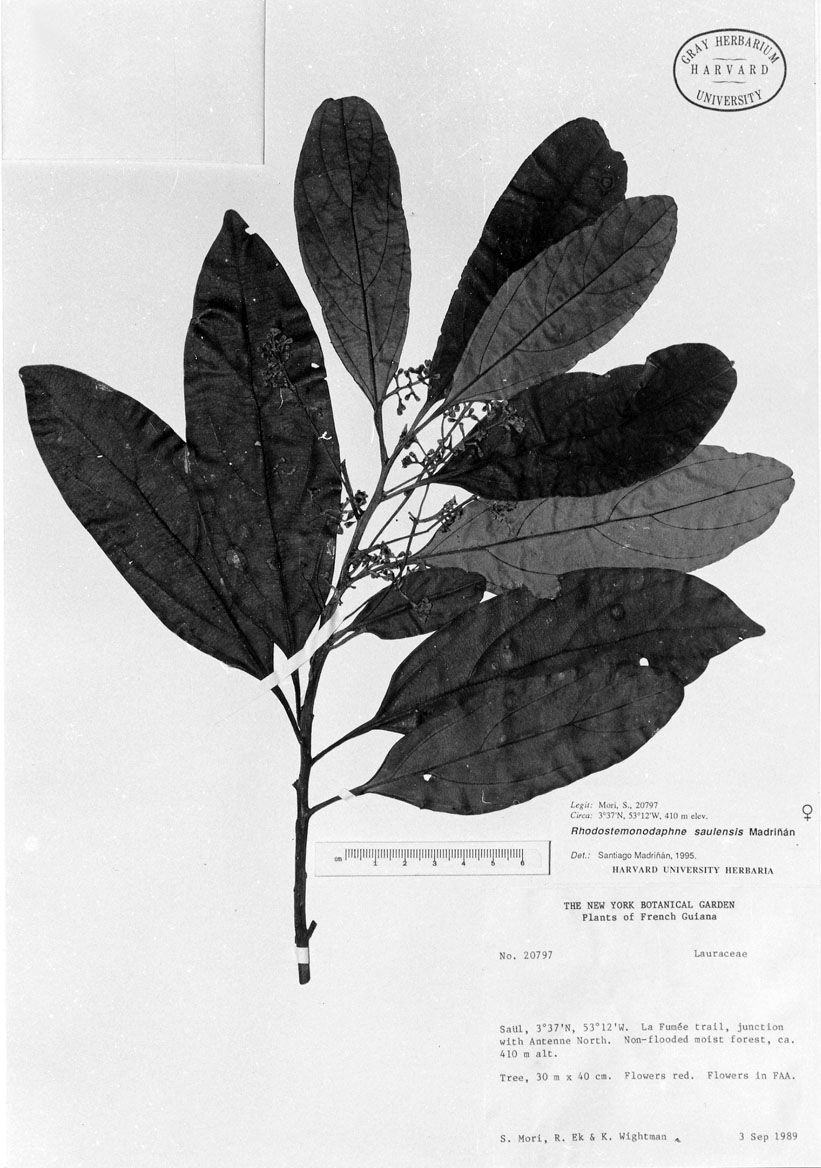
Rhodostemonodaphne saülensis Madriñán
Brittonia 48: 60, fig. 8. 1996. Type. French Guiana. Saül, Mont La Fumée, 1 Oct 1982 (stam. fl), Mori, Boom, Prance & Boeke 15014 (holotype, NY; isotypes, CAY, K, MO, U, US).
Description
Trees: branches basitonic, in axils of cataphylls; twigs angular, soon becoming terete, 3–4 mm diam.; epidermis black, barely visible due to indument cover; terminal bud slender, ca. 5 X 3 mm; cataphylls caducous; indument sericeous, caducous by next flush, the hairs dense, up to 0.2 mm long, straight, appressed, ascending, golden to silver. Leaves: petioles slender, 1.5–3.2 cm X 1.4–2.4 mm, adaxially flattened; blades chartaceous, flat, narrowly elliptic to obovate, (9–)14–17(–21) X (2–)4–7 cm; base cuneate to acute, decurrent, 40–80°; apex acute, 50–110°, ultimately acuminate for up to 2.5 cm; margin at base recurved; primary vein above flat, below prominent; secondary veins (3–)4–5(–6) pairs, equidistant, eucamptodromous, above slightly raised, below prominent, diverging at (35–)45–55°, abruptly arching near margin, chordal angle 10–20(–30)°, lowest pair more acute than rest; tertiary veins above and below slightly raised, random-reticulate to scalariform; higher order veins above flat, below slightly raised; surface above dark brown to black, below dark brown, slightly glaucous; indument above absent, below minutely sericeous, the hairs sparse, up to 0.2 mm long, straight, appressed, ascending, yellowish-brown, caducous after one flush. Staminate inflorescences: along whole length of flush, erect, peduncles 5–11 cm long, the hypopodia 2–6 cm X 0.8–1.2 mm, branch orders 3(–4), the second-order branches (6–)7–9(–10), dispersed, lowest branch up to 2 cm long, color and indument of all axes as on twigs; bracts and bracteoles caducous (not seen). Staminate flowers: pedicels ca. 5.6 X 0.8 mm, the diameter even throughout; receptacle globose, ca. 2.4 X 2.4 mm, constricted at the place of tepal inception; tepals chartaceous, ovate, ca. 2 X 2 mm, at anthesis recurved, reddish, adaxially puberulous; stamens of whorls I and II, the anthers sessile, roundish, ca. 1.4 X 1.4 mm, glabrous, the locelli 4 (median ones vestigial), apical, in a shallow arch, introrse, the glands absent; whorl III columnar, ca. 1.6 X 1 mm, glabrous, the locelli 4, the upper pair latrorse, the lower pair extrorse, the glands minute, ca. 0.2 mm diam.; whorl IV absent; all stamens reddish; pistillode absent (minute, linear, ca. 0.3 mm long, hairy). Pistillate flowers: pistil ca. 2 X 1 mm; ovary ovoid, ca. 1.2 mm long, glabrous. Fruits: pedicels up to 10 X 7 mm, gradually enlarging to form the cupule; cupule hemispherical, up to 15 X 22 mm, smooth to wrinkled, the margin straight, tepals caducous; berry elliptic, up to 30 X 15 mm.
Field notes
Trees up to (15–)25–30(–42) m tall and (28–)34(–40) cm diam.; buttresses small or absent; outer bark smooth, gray, with hoops and prominent lenticels; inner bark ca. 6 mm thick, creamy orange, granular; wood bright yellow; leaves below light green to whitish, the veins distinctly red. Pedicels reddish; tepals red with whitish margin; stamens/staminodes deep red to purple; ovary yellowish-green, stigma white. Cupule red.
Distribution (Figure 23)
Known only from the vicinity of the town of Saül in central French Guiana, at 250-410 m elev. in non-inundated rain forest. Flowers late August–October, during the dry season. Fruits ripe by April, at the height of the rainy season.
Additional specimens examined
French Guiana: Saül, Mont La Fumée, 16 Sep 1982 (st), Boom & Mori 1722 (CAY, NY); May 1982 (seedling), de Granville 5077 - A (CAY); 6 Apr 1982 (fr), ), de Granville 5077 (CAY); 28 Aug 1982 (stam. fl), Mori & Boom 14787 (clonotypes CAY, K, MO, NY, U, US); 9 Sep 1982 (stam. fl), Mori et al. 14896 (CAY, NY, U, US); 28 Aug 1989 (pist. fl), Mori & Wightman 20744 (CAY, MO, NY, U); 19 Mar 1989 (pist. fl, fr), Mori et al. 20797 (CAY n.v., GH, MO, NY, US); 15 Sep 1989 (pist. fl), Mori et al. 20904 (CAY n.v., MO, NY, US); Saül, Sentier Botanique, 17 Aug 1993 (fr), Mori et al. 23321 (NY); Saül, Eaux Claires, 4 Sep 1994 (pist. fl), Mori et al. 23821 (CAY n.v., GH, NY n.v.); 10 Sep 1994 (stam. fl), Mori et al. 23872 (CAY n.v., GH, NY n.v.).
Discussion
The specimens here described as R. saülensis have been previously identified either as R. grandis or as a new species of close affinity to it (J. G. Rohwer, in sched.). Detailed analysis of vegetative and reproductive morphology of R. grandis have resulted in the segregation of various distinct groups within this variable complex (see “The Rhodostemonodaphne grandis-complex” section above). Rhodostemonodaphne saülensis can be distinguished readily from the other species in the R. grandis-complex by its dark brown to blackish dry leaves (with reddish venation when fresh), few (4–5) pairs of lateral veins, arching near the margin to form an acute chordal angle (< 25°), and margin often recurved at base. The flowers, with their wide, laminar, overlapping anthers of whorls I and II in both staminate and pistillate individuals, and their red tepals, are also diagnostic within the R. grandis-complex. Rhodostemonodaphne grandis, the only other species from this complex in French Guiana, has 5–9 pairs of lateral veins, their chordal angle is greater than 25°, and the flowers are yellow to cream (see Table V).
Some flowers of the type specimen of R. saülensis have anthers of whorl I with only the two lower locelli fully developed, while the upper ones are vestigial.