11. Rhodostemonodaphne capixabensis
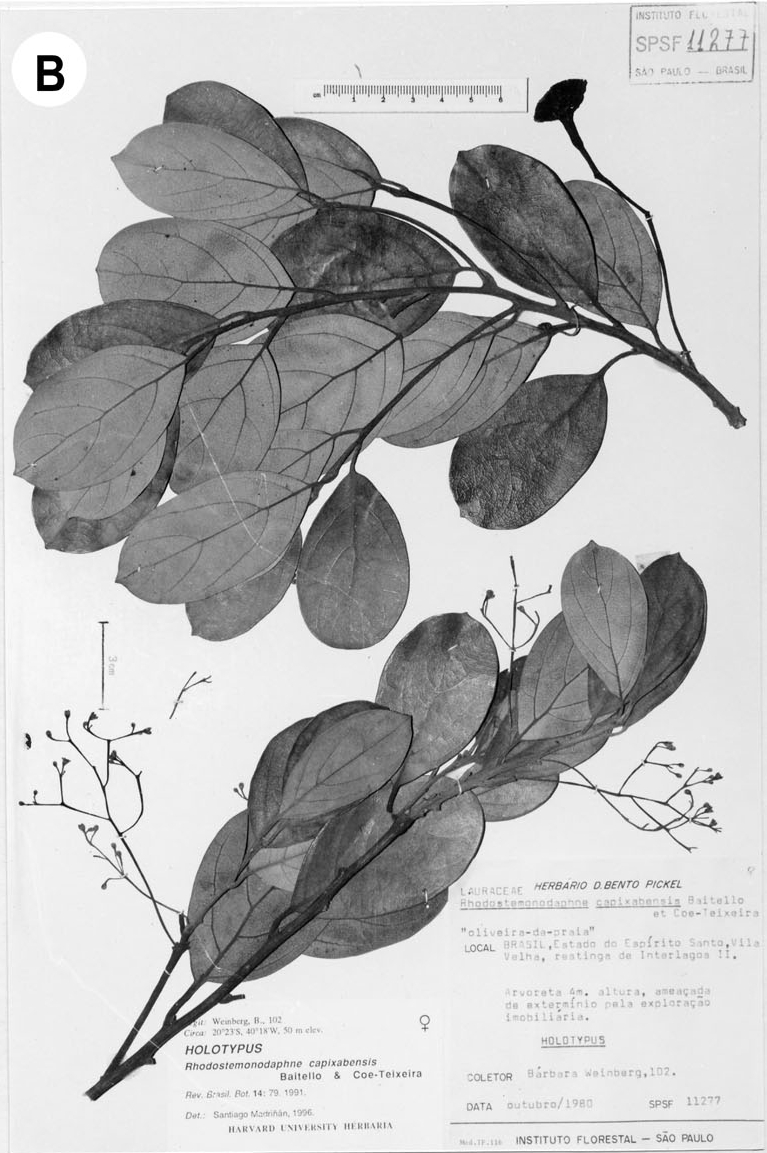
Rhodostemonodaphne capixabensis Baitello & Coe-Teixeira
Rev. Brasileira Bot. 14: 79, fig.1. 1991. Type. Brazil. Espírito Santo: Villa Velha, Interlagos II, Oct 1980 (pist. fl, fr), Weinberg 102 (holotype, SPSF; isotype, VIES n.v.).
Local names. Canela do nativo, oliveira-da-praia.
Description
Trees to shrubs: branches basitonic, in axils of cataphylls; twigs angular and remaining so for at least two flushes, ca. 3 mm diam.; epidermis brownish; terminal bud plump, ca. 5 X 3 mm; cataphylls caducous; indument tomentose, caducous by next flush, the hairs dense, up to 0.8 mm long, curved, erect, brownish. Leaves: petioles robust, 0.6–1.7 cm X 1.2–1.8 mm, adaxially flattened; blades chartaceous, flat, broadly elliptic to obovate, (4–)7–9(–11) X (2–)3–6 cm; base obtuse to rounded, 70–110°; apex obtuse to rounded, 90–140°, (mucronate); margin plane; primary vein above flat to slightly raised, below prominent; secondary veins (3–)4(–5) pairs, equidistant, eucamptodromous, above flat, below raised, diverging at 50–55°, abruptly arching near margin (forked), chordal angle 20–25°, the angle uniform along blade length; tertiary veins above flat, below slightly raised, random-reticulate; higher order veins above flat, below slightly raised; surface above olive-green to greenish-brown, below light green to brown, conspicuously glaucous; indument above absent, the primary vein puberulous, below puberulous, the hairs sparse to isolated, up to 0.3 mm long, straight to curved, erect, yellowish, caducous after one flush. Staminate inflorescences: mesotonic to acrotonic, erect, peduncles 7–13 cm long, the hypopodia 3–7 cm X ca. 1 mm, branch orders 4–5, the second-order branches 4–6, dispersed, lowest branch up to 4(–7) cm long, all axes dark brown, puberulous to glabrous; bracts and bracteoles caducous (not seen). Staminate flowers: pedicels 7–12 X ca. 0.8 mm, the diameter gradually increasing apically; receptacle obconical, ca. 2 X 2.2 mm; tepals chartaceous, ovate, ca. 2.5 X 2 mm, at anthesis erect to spreading, yellowish-brown, translucent, adaxially puberulous; stamens of whorls I and II spathulate, the anthers oblong inflexed, ca. 1.6 X 0.8 mm, glabrous, the locelli 4, apical, in a shallow arch, introrse, the glands absent; whorl III filiform, ca. 2.4 X 0.8 mm, glabrous, the anthers oblong, the locelli 4, the upper pair latrorse, the lower pair extrorse, the glands globular, ca. 1.5 mm diam.; whorl IV absent; all stamens reddish; pistillode filiform, ca. 1.5 X 0.3 mm, glabrous. Pistillate flowers: pistil ca. 2.5 X 1.2 mm; ovary ovoid, ca. 1.5 mm long, glabrous. Fruits: pedicels up to 15 X 3 mm, gradually enlarging to form the cupule; cupule trumpet-shaped, up to 13 X 20 mm, smooth, the margin straight, tepals caducous; berry elliptic, up to 25 X 20 mm.
Field notes
Trees to shrubs up to 8 m tall and 12 cm diam., already flowering when 4 m tall; outer bark rough; leaves below glaucous (bluish). Inflorescence axes greenish; receptacle purple; tepals reddish. Cupule red; berry greenish-brown.
Distribution (Figure 7)
This species is known from only three localities in the state of Espírito Santo on the Atlantic coast of Brazil. It grows on sandy, coastal forest (restinga) up to 50 m elev. Flowers September–October, at the beginning of the rainy season. Fruits are ripe February–March.
Additional specimens examined
Brazil.Espírito Santo: Linhares, CVRD Forest Reserve, 22 Oct 1981 (stam. fl), Folli 334 (MO X2); Villa Velha, Interlagos, 21 Sep 1982 (stam. fl), O. J. Pereira & Fontenella 181 (SPSF, VIES n.v.); Villa Velha, Jacaranema, 21 Oct 1987 (pist. fl, imm. fr), O. J. Pereira 1205 (SPSF, VIES n.v.); Conceição da Barra, 27 Feb 1994 (fr), O. J. Pereira et al. 2883 (SPSF); Linhares, CVRD Forest Reserve, 23 Sep 1982 (pist. fl), I. A. Silva 345 (CVRD n.v., MO X2, SPSF X2); Villa Velha, Interlagos I, Nov 1980 (stam. fl), Weinberg 01-A (MBML n.v., MO).
Discussion
Rhodostemonodaphne capixabensis has broadly elliptic, often mucronate, strongly chartaceous leaves that are glaucescent abaxially, and slender, profusely- and long-branched, glabrous inflorescences, unlike any other species in the genus. It can be distinguished from the only other species of Rhodostemonodaphne with overlapping range, the apparent close relative R. macrocalyx, by a number of vegetative and androecial characters. In the northern part of its range R. macrocalyx has elliptic to narrowly elliptic, long-acuminate leaves. The stamens in R. capixabensis are spathulate, with the locelli arranged in an arch, while in R. macrocalyx they are filiform with bijugate anthers (see Table VIII).
The paratype I. A. Silva 345 may in fact be a hybrid between R. capixabensis and R. macrocalyx. It differs from all the other collections of R. capixabensis in a variety of characters, these being intermediate between the two species. The indument is dark golden to reddish; the leaves are narrower, being elliptic, and are not glaucous; the secondary veins are oriented at a shallower angle (ca. 30°), and the apex of the lamina has a longer mucro. The stamens are nevertheless spathulate, agreeing with those of other collections of R. capixabensis.
Due to the lack of mature flowers on the only specimen available to me of O. J. Pereira 1205 (SPSF), I could not confirm the observation by Baitello and Coe-Texeira (1991) that this plant had at least two flowers with staminate characters. While it is common to find pistillate individuals with well-developed dehiscing anthers, I have never seen pollen within the locelli of these anthers, or even after forcing open anthers that have not dehisced. Although there are reports of finding both staminate and pistillate flowers in one individual of an otherwise dioecious species of Lauraceae, this condition is extremely rare (cf. Ocotea tenera Mez & J. D. Smith; Wheelwright & Bruneau, 1992).
This is one of the few species for which information on its conservation status is available. Not only does this species have a limited distribution range, but it also seems to be restricted to a very specific habitat. In both the collection labels and the species description (Baitello & Coe-Teixeira, 1991) it is mentioned that the sandy coastal forests on which it grows are being depleted at an alarming rate primarily due to housing development projects. For the above reasons it should be considered as a species threatened with extinction, and conservation efforts should be encouraged. The authors also mention Weinberg’s suggestion (in Weinberg, 1984, unavailable to me) that the species is of horticultural interest for its decorative qualities as a small, shade tree, with shiny, greyish leaves and colorful infructescences.