38. Rhodostemonodaphne praeclara
Rhodostemonodaphne praeclara (Sandwith) Madriñán, comb. nov.
Nectandra praeclara Sandwith, Kew Bull. 46: 224. 1932. Type. Guyana. Mazaruni-Potaro: Essequibo River, Wallaba forest, Moraballi Creek, 7 Oct 1929 (stam. fl), Sandwith 387 (holotype, K; isotypes, F [frag. ex G], G [photo F neg. 27606], K, P, S [photo NY neg. 8558], U, US).
Local names. Venezuela: laurel grande; Guyana: shirua, buradié (Arawak); broad-leaved soft silverballi.
Description
Trees: branches basitonic, in axils of cataphylls; twigs angular, soon becoming terete, 4–5(–6) mm diam.; epidermis brownish to black, barely visible due to indument cover; terminal bud slender, ca. 7 X 3 mm; cataphylls caducous; indument sericeous, caducous by next flush, the hairs dense, up to 0.3 mm long, straight, appressed, ascending, golden to silver. Leaves: petioles robust, 1.5–2.8 cm X 2.2–3.6 mm, adaxially flattened; blades chartaceous, flat, narrowly elliptic to obovate, 7–19 X 3–6(–9) cm; base cuneate to acute or obtuse, minutely decurrent, 50–90°; apex rounded, 100–130°, (mucronate); margin plane; primary vein above flat, below prominent; secondary veins 4–6 pairs, equidistant, eucamptodromous, above slightly raised, below raised, diverging at 45–60°, abruptly arching near margin, chordal angle 20–30°, the angle uniform along blade length; tertiary veins above and below slightly raised, random-reticulate to scalariform; higher order veins above and below slightly raised; surface above and below brown to olive-green; indument above absent, below minutely sericeous, the hairs sparse, up to 0.3 mm long, straight, appressed, ascending, yellowish to translucent, caducous after one flush. Staminate inflorescences: along whole length of flush, erect, peduncles 6–16 cm long, the hypopodia 3–8 cm X ca. 1.6 mm, branch orders 4, the second-order branches 10–14, dispersed, lowest branch up to 2 cm long, color and indument on all axes as on twigs; bracts and bracteoles caducous (not seen). Staminate flowers: pedicels ca. 5.6 X 0.8 mm, the diameter even throughout; receptacle globose, ca. 2 X 2.4 mm, constricted at the place of tepal inception; tepals membranaceous, ovate, ca. 2 X 2 mm (inner whorl slightly smaller), at anthesis recurved, reddish, adaxially puberulous; stamens of whorls I and II, the anthers sessile, oblong, ca. 0.6 X 0.8 mm (whorl II slightly smaller), glabrous, the locelli 4, apical, in a shallow arch, introrse, the glands absent; whorl III columnar, ca. 1.2 X 0.6 mm, glabrous, the anthers globose, the locelli 4, the upper pair latrorse, the lower pair extrorse, the glands absent; whorl IV absent; all stamens reddish; pistillode absent. Pistillate flowers: pistil ca. 2.6 X 1.4 mm; ovary ovoid, ca. 1.6 mm long, glabrous. Fruits: pedicels up to 12 X 6 mm, abruptly enlarging to form the cupule; cupule hemispherical, up to 15 X 23 mm, tuberculate, the margin straight, tepals caducous; berry unknown.
Field notes
Trees up to 30 m tall and 30 cm diam., already flowering when 9 m tall; buttresses ca. 100 cm tall; outer bark smooth, dark; wood aromatic; leaves above dark green, the veins yellow, leaves below light green to glaucous. Inflorescence axes reddish; pedicels reddish; receptacle reddish; tepals creamy yellow; stamens/staminodes green. Cupule reddish-green to purple.
Distribution (Figure 23)
Northeast Venezuela to north-central Guyana, at 250(–700) m elev., in non-inundated, lowland rain forest; also in upland rain forest, up to 1200 m elev. (the two Steyermark collections from the Gran Savana and the two Marcano-Berti collections from the Imataca range). Flowers September–November, January–February, during the dry season. Fruits March–April, at the beginning of the rains; cupules from old fruits have been found in June.
Additional specimens examined
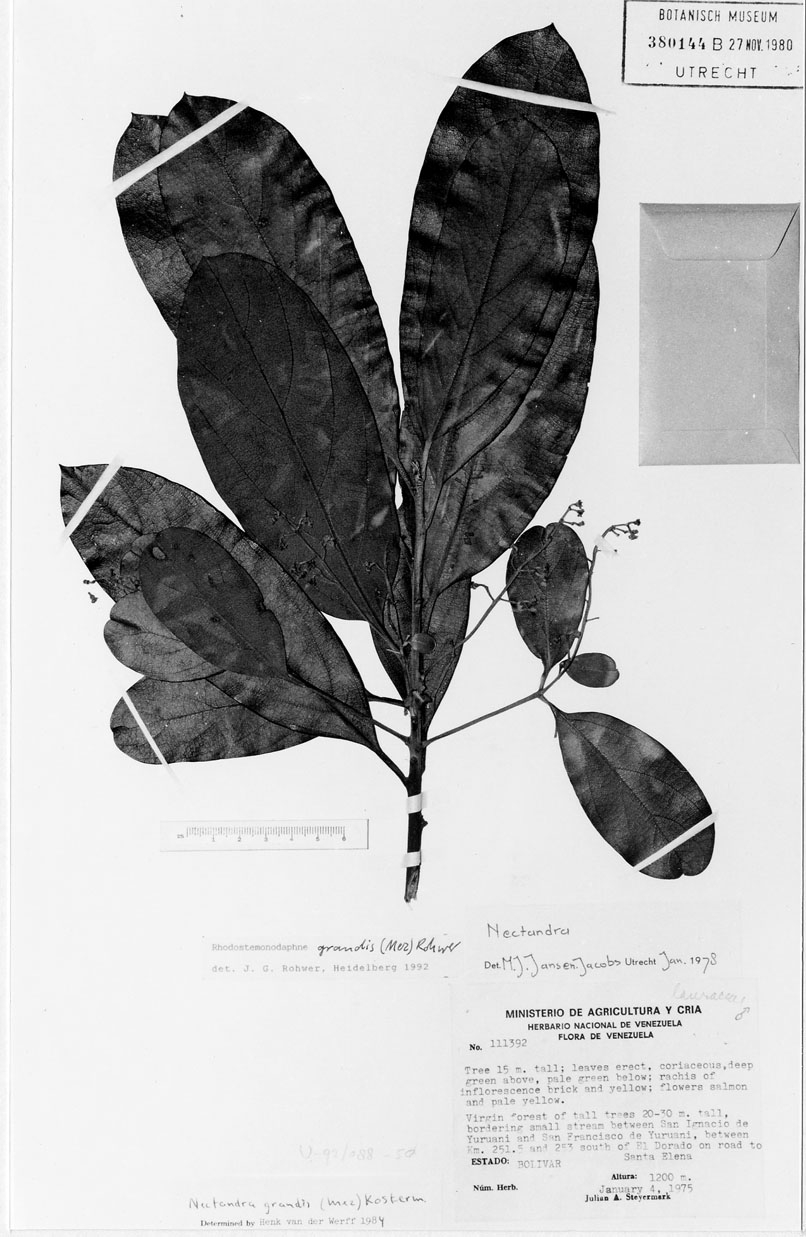
Venezuela. Amazonas: Atabapo, Río Parú, Oct 1989 (fr), Delgado 741 (MO). Bolívar: Sucre, Helipuerto 23, May 1990 (fr), Delgado 1038 (MO, NY); Imataca Forest Reserve, La Quebrada camp, 23 Jun 1964 (fr), Marcano-Berti 248 (F, G X2, HBG X3, MER, MO, NY, US); 24 Jun 1964 (fr), Marcano-Berti 254 (F, HBG X2, K, MER, MO X2, NY, U X2, US X2); Quebrada O-paru-má, between Santa Teresita de Kavanayén and Río Pacairao, 20 Nov 1944 (pist. fl), Steyermark 60403 (F X2); between San Ignacio and San Francisco de Yuruani, 4 Jan 1975 (stam. fl), Steyermark 111392 (F, HBG, NY, U). Delta Amacuro: E of Río Grande, E-NE of El Palmar, near the border of Bolívar, Sep 1965 (stam. fl), Blanco 278 (G, HBG X2, MO X2, NY); Antonio Díaz, 8 km N of Wausa, right bank of Río Amacuro, Feb 1987 (pist. fl), Fernández 3915 (HBG, MO X2, NY).
Guyana. Mazaruni-Potaro: Demerara-Essequibo Railway, Anarika Line, near Monkey Creek, 21 Mar 1910 (fr), Anderson 62 (K); Essequibo River, Wallaba forest, Moraballi Creek, 4 Nov 1938 (stam. fl), Davis 596 = FD 2716 (FHO, U); 13 Oct 1938 (stam. fl), Fanshawe 130 = FD 2739 (FHO, G, NY, S); Essequibo River, Wallaba forest, Winiperu Creek, 13 Apr 1940 (fr), Fanshawe 450 = FD 3186 (FDG); Essequibo River, Wallaba forest, Moraballi Creek, 29 Oct 1929 (stam. fl), Sandwith 535 (K).
Discussion
Rhodostemonodaphne praeclara is another species segregated from the R. grandis-complex (see “The Rhodostemonodaphne grandis-complex” section above). As delimited here, it can be recognized by its coriaceous, slightly obovate, mucronate leaves and absence of paired glands on the stamens of whorl III. It is found in a fairly circumscribed area–-E Venezuela and adjacent Guyana–-the only member of the R. grandis-complex growing there. A specimen from Mt. Roraima (Steyermark 59001), previously identified as R. grandis, is vegetatively similar to the upper-montane collections of R. praeclara, but it has erect tepals, and clavate, sessile, two-locellate anthers, as in some Amazonian specimens determined as Endlicheria metallica Kostermans.
Eighteen specimens previously identified as R. grandis, with variable vegetative morphology and collected throughout the Amazon river basin, still present an unsolved problem in delimitation. These differ from R. praeclara s. str. not only vegetatively, but also are found beyond the limited geographical range where the well-defined morphological group described above is found. However, the twelve fertile specimens have flowers identical to those of R. praeclara, including stamens of whorl III which are devoid of glands. I have annotated the Venezuelan/Guyanan specimens as R. praeclara s. str. The remaining heterogeneous group has been annotated as R. praeclara s.l. and the specimens in it are listed below. These specimens to a certain extent link R. saülensis, from central French Guiana, R. peneia from Manaus and its surroundings, and R. praeclara from the Venezuela-Guyana border. It is because of these specimens, together with the fruiting/sterile material of E. metallica misidentified as R. grandis, that the R. grandis-complex came to be recognized as a widespread variable taxon. For a list of characters distinguishing R. praeclara s. str., R. praeclara s.l., and other species of the R. grandis-complex see Table V.
Specimens annotated as Rhodostemonodaphne praeclara s.l.
Colombia. Amazonas: Soratama, Río Apaporis, between Río Pacoa and Río Kananarí, 31 Aug 1951 (stam. fl), Schultes & Cabrera 13805 (BM, C, GH, NY, US, U).
Venezuela. Atures: Serranía Yutajé, Río Manapiare, 18 Jun 1976 (fr), Berry 2255 (G, MO, MYF, NY, U); Department Atabapo, Pandamo river plain, Feb 1990 (fr), Marin 805 (MO). Bolívar: Cerro Cuquenán, S of Mun. Urdaneta, Dtto. Riosucio, 16 Apr 1986 (fr), Hernández & Dezzeo 235 (HBG, US).
Ecuador. Morona-Santiago: Valley of Río Zamora, ca. 50 km NE of Yatanza, 17 Nov 1982 (pist. fl), T. D. Pennington & Tenorio 10760 (QCA). Napo: Yasuní river and Jatun-Cocha lakes, 29 Sep 1988 (stam. fl), Cerón & Gallo 5170 (MO).
Peru. Amazonas: Bagua province, Marañon river, Kusu-Chapi creek, Feb 1995 (sterile), R. Vásquez et al. 19409 (GH, MO n.v.); (sterile), R. Vásquez et al. 19472 (GH, MO n.v.).
Brazil. Amazonas: Basin of Rio Juruá, near mouth of Rio Embira, 10 Jun 1933 (stam. fl), Krukoff 4747 (A, F, G, K, M, MO, NY, S, SP, U, US); 4 Jul 1933 (pist. fl), 5171 (A, BM, F X2, G, M, MO, NY, S, SP, U, US); Mun. Manaus, Fazenda Esteio, 17 Sep 1980 (stam. fl), J. L. dos Santos (INPA/WWF)1202.5028 (MO); Serra da Neblina, 22 Dec 1965 (pist. imm. fr), N. T. Silva & Brazão 60720 (MO, NY X2); Mun. Manaus, Ducke Forest Reserve, 5 Apr 1994 (fr), Vicentini et al. 468 (INPA, MO). Pará: Serra dos Carajás, Serra do Norte, 30 May 1983 (stam. fl), M. F. F. Silva et al. 1411 (HBG); Jacundá, Rio Tocantins, Rio Cajazeiras, 16 May 1978 (pist. fl), M. G. Silva & Bahia 3604 (HBG, MO, NY); Serra dos Carajás, AMZA camp 4-Alfa, 6 Jun 1982 (pist. fl bud), Sperling et al. 5928 (MO). Rondônia: Espigão do Oeste, BR 364, estrada da FUNAI, Km 5, 20 Jun 1984 (pist. fl), Cid et al. 4658 (F, GH, MO, NY, US); Mun. Jiraparaná, Gleba G. Km 2, 29 Mar 1983 (stam. fl), Ferreira-P.-F. 83-31 (HBG).