Description
Trees: branches basitonic, in axils of cataphylls or basal foliage leaves; twigs angular, soon becoming terete, 7–12 mm diam.; epidermis black; terminal bud plump to slender, ca. 2 X 1 mm; cataphylls persisting on current flush or caducous, up to 1.5 mm long; indument pubescent to tomentose or puberulous, caducous after one flush, the hairs dense to sparse, up to 1.2 mm long, curved to crisped, erect, reddish to golden. Leaves: petioles slender to robust, 1–2.5(–5) cm X ca. 5 mm, adaxially flattened; blades chartaceous, flat, narrowly to broadly ovate to elliptic or oblong, (10–)15–30(–40) X 5–10(–19) cm; base acute to obtuse or rounded, 80–110(–140)°; apex acute to obtuse, (40–)70–90°, ultimately acuminate for up to 3.5 cm; margin plane; primary vein above flat to impressed, below prominent; secondary veins 10–16(–20) pairs, equidistant, eucamptodromous (apically brochidodromous), above flat to impressed, below prominent, diverging at 45–60°, abruptly arching near margin, chordal angle 35–40°, the angle decreasing apically; tertiary veins above flat to slightly raised, below raised, conspicuously scalariform; higher order veins above slightly raised, below raised; surface above olive-green to brown, the veins darker, below dark green to light brown; indument above absent, the primary vein tomentose, below puberulous to pubescent, the hairs dense to sparse, up to 1.8 mm long, straight to curved to crisped, erect, yellowish to ferruginous, denser on the veins, persisting for at least two flushes. Staminate inflorescences: along whole length of flush, erect, peduncles 6–23 cm long, the hypopodia 1–6 cm X 1–4 mm, branch orders 3–6, the second-order branches 8–16, dispersed, lowest branch up to 3(–7) cm long, color and indument of all axes as on twigs; bracts and bracteoles caducous (not seen). Staminate flowers: pedicels ca. 4 X 1 mm, the diameter even throughout; receptacle globose, ca. 2.8 X 1.5 mm, constricted at the place of tepal inception; tepals chartaceous to coriaceous, ovate, ca. 2 X 1.6 mm, at anthesis spreading, reddish-brown, adaxially minutely puberulous; stamens of whorls I and II spathulate, the anthers reniform, ca. 1.2 X 1.2 mm, puberulous, the locelli 4, apical, in a shallow arch, the upper pair introrse, the lower pair latrorse, the glands absent; whorl III capitate, ca. 1.4 X 0.8 mm, puberulous, the locelli 4, the upper pair extrorse, the lower pair latrorse (to extrorse), the glands globular, ca. 0.8 mm diam.; whorl IV absent; all stamens brownish; pistillode filiform, ca. 2 X 0.8 mm, glabrous. Pistillate flowers: pistil ca. 3.2 X 2 mm; ovary ovoid to globose, ca. 2.4 mm long, glabrous. Fruits: pedicels up to 15 X 3 mm, abruptly enlarging to form the cupule; cupule hemispherical, up to 15 X 20 mm, smooth to tuberculate, the margin straight, tepals caducous; berry elliptic, up to 30 X 20 mm.
Additional specimens examined
Costa Rica. Alajuela: Monteverde Biological Reserve, Río Peñas Blancas, 25 Feb 1987 (pist. fl), Haber & Cruz 6791 (CR n.v., F, MO). Cartago: Turrialba, in forest behind CATIE, 18 Mar 1987 (pist. fl), Davidse et al. 25600 (MO); (pist. fl), Gómez & Herrera 23064 (MO). Heredia: La Selva, 5 Dec 1980 (st), Hammel 10494 (MO); (fr, seedling), Hammel 10693 (MO); 22 Feb 1982 (pist. fl), Hammel 11226 (MO); 10 Jan 1973 (pist. fl), Hartshorn 1082 (MO); 12 Jul 1973 (fr), Hartshorn 1256 (MO); 27 Feb 1982 (stam. fl), Perry s.n. (MO, NY). Limón: Cordillera de Talamanca, Hitoy Cerere Biological Reserve, Cerro Bobócara, 15 Feb 1989 (stam. fl), Herrera & Chacón 2397 (B, BM, F, GH, MO); Cerro Coronel, E of Laguna Danto, 16 Mar 1987 (st), Stevens et al. 24903 (MO). Puntarenas: Cantón de Osa, Rancho Quemado, Rincón, Río Riyito, 15 Jul 1990 (fr), Herrera 4263 (MO); Corcovado Sirena National Park, Anacardium trail, 22 May 1989 (fr), Kernan & P. Phillips 1105 (MO). San José: El General basin, Mar 1940 (stam. fl), Skutch 4757 (A, F n.v., G [frag. ex F], MO, NY n.v., US).
Panama .Bocas del Toro: Almirante, Cricamola valley, 13 Feb 1928 (stam. fl), G. P. Cooper 498 = (Y)12116 (F n.v., FHO, G [frag. ex F], K, MAD, S).
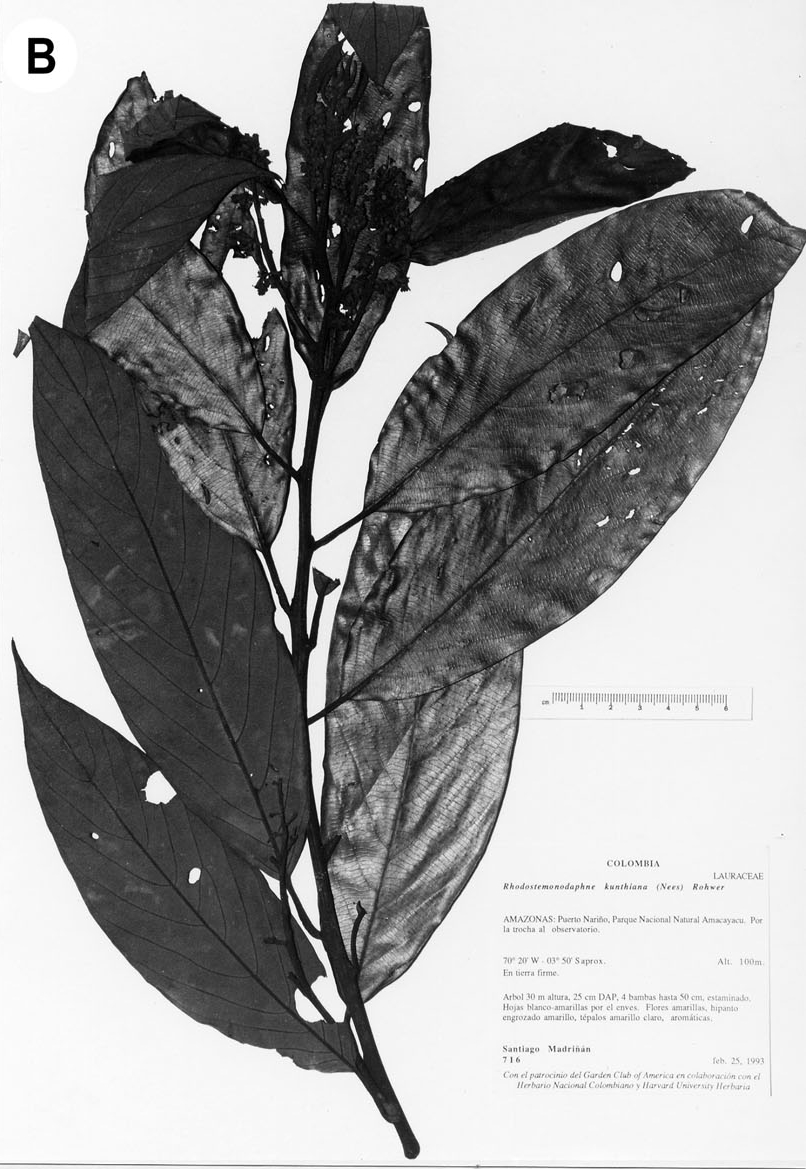
Colombia. Amazonas: Puerto Nariño, Amacayacú National Park, 25 Feb 1993 (stam. fl), Madriñán 716 (COL, FMB, GH, MA); Soratama, Río Apaporis, between Río Pacoa and Río Kananarí, 20 Aug 1951 (pist. fl), Schultes & Cabrera 13687 (COL, U, US); Leticia, near airport on roadside to Tarapacá, 8 Sep 1963 (pist. imm. fr), Soejarto & Cardozo 626 (COL, F, GH, US). Antioquia: Guatapé, Santa Rita, Finca Montepinar, 23 Jul 1987 (pist. imm. fr), Albert de Escobar et al. 7835 (HUA, MO X2); San Luís, Piedra del Castrillón, 12 Aug 1987 (pist. fl, imm. fr), Daly & Betancur 5358 (HUA, MO, NY); Anorí, between Providencia and Alhibe, 20 Feb 1976 (stam. fl), Soejarto et al. 4461 (F, HUA); (stam. fl), Soejarto et al. 4502 (F, HUA, NY). Chocó: Riosucio, Los Katíos National Park, 29 Sep 1979 (st), Barbosa 1229 (FMB X3). Guajira: Sierra Nevada de Santa Marta, Mingueo, bosque La Cueva, 21 Aug 1986 (st), Gentry & Cuadros 55420 (MO, JBGP). Meta: Tinigüa National Park, Sierra de la Macarena, Mt. Chamusa, Jul 1993 (fr), Stevenson 500 (MO).
Venezuela. Amazonas: Upper Río Orinoco, 1951 (stam. fl), Croizat 917 (NY); Atabapo, Salto Yureba, Caño Yureba, Bajo Ventuari, 24 Oct 1981 (stam. fl), Delascio & Guánches 10930 (MO); Río Negro, Cerro de La Neblina, Río Mawarinuma, 5 Feb 1984 (stam. fl), Liesner 15655 (AAU, F, MO, NY, US); Río Negro, Cerro de La Neblina, 21 Mar 1984 (fr), Liesner & Stannard 16935 (MO, NY, US); (fr), Liesner & Stannard 16949 (AAU, F, MO, NY, US). Aragua: Henri Pittier National Park, 9 Aug 1983 (stam. fl), Field 154 (NY); Nov 1952 (stam. fl), Lanes 31819 (K); 5 Apr 1959 (stam. fl), Trujillo 4122 (U); 30 Nov 1938 (stam. fl), Williams & Alston 114 (BM); 29 Nov 1938 (stam. fl), 10718 (F, NY, VEN n.v. ); (stam. fl), Williams & Alston 10728 (VEN n.v. ). Barinas: Río Acequia, SW of junction of rd. to Ciudad Bolivar, 25 Aug 1966 (stam. fl), Steyermark & Rabe 96512 (NY); Río Zulia, Los Diques, Santa Barbara de Barinas, 31 May 1989 (fr), Valverde & Peña 1138 (MO). Bolívar: Dtto. Cedeño, Along Río Mawela, tributary of the Erebato, 16 Mar 1992 (fr), Boom & Marin 10536 (MO, NY); Dtto. Cedeño, Río Nichare, May 1988 (fr), Elcoro 324 (MO); Dtto. Cedeño, Serranía de Maigualida, 20 km E of San José de Kayamá, Apr 1989 (pist. imm. fr), Fernández 5476 (MO, NY); Tabaro river, Dedemai camp, 23 Nov 1991 (stam. fl), Goldstein & Salas 97 (MO); (fr), Salas TT-205 (MO); woods 3-4 km SE of “Los Patos” N of Río Hacha and N of Río Supamo, 30 km S of El Manteco, 9 Aug 1960 (fr), Steyermark 87031 (G, NY); Cerro Venamo, 8 Jan 1964 (pist. imm. fr), Steyermark et al. 92862 (F, G, K, NY X2, P, US). Falcón: Cerro La Mina, Mun. Jacura, Dtto. Acosta, 14 Nov 1979 (fr), Marcano-Berti et al. 448-979 (HBG). Merida: El Vigía, Caño Amarillo, 28 Jan 1955 (fr), Bernardi 1862 (G X2, NY). Miranda: Cerros del Bachiller, 20 Mar 1978 (fr), Steyermark & Davidse 116883 (MO). Zulia: Dtto. Bolívar, between El Pensado (town some 4 km E from Quirós) and Las Tres Marías, 8 km E from El Pensado, 16 Feb 1980 (fr), Bunting & Stoddart 9056 (NY); Sierra de Perija, Quebrada Perija, tributary of Río Tokuku, SW of Los Angeles de Tokuku mission, SW of Machiques, 29 Aug 1967 (stam. fl), Steyermark 99866 (HBG, NY).
Guyana. Mazaruni-Potaro: Upper Mazaruni River Basin, Mount Ayanganna, 16 Aug 1960 (fr), Tillett et al. 45660 (NY X2). Rupununi: Wabuwak, Kanuku Mts., Oct 1948 (stam. fl), Wilson-Browne 379 = FD 5793 (FDG, NY X2). State not indicated: Without locality, 1841 (stam. fl), Schomburgk 798 (BM, G X2, MO, NY, P).
Surinam. Marowijne: Upper Litany, 3 Aug 1993 (stam fl), de Granville et al. 12022 (CAY n.v., MO). Saramacca: Emma Keten, 19 Mar 1922 (fr), Gonggrijp & Stahel 188 (U). State not indicated: Laida, 10 Aug 1908 (pist. fl, imm. fr), Tresling 343 (U).
French Guiana: Tumuc Humac, 26 Aug 1972 (stam. fl), de Granville B-4469 (CAY, HB, NY, U X2); Rivière Comté, between Roche Fendée and Bélizon, 7 Feb 1973 (fr), de Granville B-4667 (CAY X2, NY, P, U); Saut Ananas, 12 Aug 1981 (stam. fl), de Granville 4819 (MO, U); Cayenne, 1804 (fr), Martin s.n. [65 in BM] (BM X4, MO); Saül, Mont La Fumée, 1 Jun 1986 (stam. fl bud), Mori et al. 18234 (CAY, MO, NY, U); Saül, Eaux Claires, 26 May 1992 (fl bud), Mori et al. 22324 (MO, US); 28 Oct 1992 (pist. imm. fr), Mori et al. 22670 (MO); Rivière Comté, Crique Galibi, on Crique Rupèrt, 22 Jul 1967 (fl bud), Oldeman B.1119 (CAY, U); Rivière Comté, between Roche Fendée and Bélizon, 21 Jul 1965 (st), Mori et al. 1448 (US).
Ecuador. El Oro: Hacienda Ingenio, 15 km S of Piedras, 20 Jun 1943 (st), Little 6646 (F, NY). Esmeraldas: Quinindé, Río Guayllabamba, 5 Oct 1965 (fr), Little & Dixon 21238 (MO, NY X3, US X3); Anchayacu, Eloy Alfaro, Mayronga, 15 Apr 1994 (fr), T. D. Pennington et al. 14950 (MO); San Lorenzo, parroquia Alto Tambo, sector El Cristal, 13 Apr 1992 (stam. fl), Tipaz et al. 794 (G, MO X2). Los Ríos: Quevedo, Río Palenque, 2 Oct 1976 (st), Dodson & Gentry 6326 (MO, QCA); (st), Dodson & Gentry 6339 (MO); (stam. fl), Dodson & Gentry 6412 (AAU, MO, NY, QCA X2); 7 Oct 1976 (stam. fl), Dodson & Gentry 6564 (MO); 5 Mar 1977 (fr), Dodson & Gentry 6658 (AAU, F, MO); 5 May 1983 (stam. fl), Dodson & Dodson 13675 (F, MO); 19 Jun 1991 (stam. fl bud), Palacios & Freire 7412 (MO); 15 Jul 1991 (stam. fl), van der Werff et al. 12358 (MO). Morona-Santiago: Pachicutza, 14 Sep 1975 (pist. fl), Little et al. 355 (COL, MO, US); Taisha, 16.7 km NE, 14 Aug 1976 (stam. fl), Ortega 005 = 056 (US X2); Taisha, 23 Sep 1976 (st), 211 (US); Montalvo, 1 Jul 1989 (stam. fl), Zak & Espinoza 4452 (MO). Napo: Yasuní, 16 Jan 1988 (fr), Cerón 3435 (AAU, C, HBG, INPA, MO, NY, QCA, US); San Jose de Payamino, 27 Apr 1984 (st), Irvine 996 (F); Estación Biológica Jatun Sacha, 3 Jul 1987 (stam. fl), Palacios 1689 (HBG, MO, NY, QCA, US); Archidona, 20 Mar 1989 (fr), Palacios 4044 (MO); Canton El Chaco, Las Palmas, Finca Carmita, 12 Oct 1990 (stam. fl), Palacios 6247 (MO); (pist. fl), Palacios 6251 (MO, NY n.v.). Pastaza: Pastaza, 1 Aug 1990 (stam. fl), Gudiño 533 (MO); Río Tigüino, 7 Jan 1989 (fr), Hurtado et al. 1293 (MO, NY).
Peru. Amazonas: Chachapoyas, Rodríguez de Mendoza, Cochamal, Tinas, Yanamonte, 3 Jul 1991 (stam. fl), Díaz et al. 4532 (MO); Río Santiago, Caterpiza, 26 Oct 1979 (fr), Huashikat 1070 (HBG, MO); Quebrada Chigki Shinuk, 31 Jan 1973 (fr), Kayap 279 (F, MO); Bongara, 31 Aug 1983 (pist. fl, imm. fr), D. N. Smith & S. Vásquez 4905 (MO X2); Bagua province, Marañón river, Kusu-Chapi creek, Feb 1995 (sterile), R. Vásquez et al. 19537 (GH, MO n.v.); (sterile), R. Vásquez et al. 19541 (GH, MO n.v.). Cajamarca: La Palma, 4 Feb 1988 (st), Gentry et al. 61109 (MO); (pist. fl, fr), Gentry et al. 61141 (AAU, F, MO, NY). Junín: Santiago, Río Tambo, 18 Apr 1981 (stam. fl), Reynel-R. 197 (F, MO). Loreto: Quebrada Tahuayo above Quebrada Tamishiyaco, 27 Aug 1972 (stam. fl), Croat 19790 (AAU, G, F, MO X2, NY, U); Yurimaguas, Río Huallaga, 11 Feb 1924 (stam. fl), J. G. Kuhlmann 20050 (U); Maynas, Alpahuayo, 14 Nov 1984 (fr), R. Vásquez et al. 5950 (F, HBG, MO, NY); Maynas, Iquitos, Río Nanay, Puerto Almendras, 18 Sep 1988 (stam. fl), R. Vásquez & N. Jaramillo 11035 (HBG, MO). Madre de Dios: Tambopata, 29 May 1987 (st), Gentry & N. Jaramillo 57819 (MO X2); Manu, 18 Aug 1989 (pist. fl), Núñez et al. 11424 (GH, HBG, MO); Tambopata, 7 Jul 1989 (stam. fl), O. Phillips et al. 182 (MO); Manu, Puesto Pakitza, 4 Oct 1987 (st), Sobrevila et al. 1871 (MO). Pasco: Palcazú, 20 Jun 1198 (pist. fl), Hartshorn et al. 2630 (MO); Oxapampa, Palacazú, 22 Sep 1986 (st), Pariona & Ruíz 963 (MO); Oxapampa, Bermúdez, 10 Nov 1980 (fr), Reynel-R. 39 (MO); Oxapampa, 2 Dec 1982 (fr), D. N. Smith 2886 (MO, NY); 23 Aug 1967 (pist. fl), E. Vásquez 119 (K X3, MO X2); (pist. fl), 120 (MO, US); Oxapampa, Villa Rica, 27 Feb 1986 (pist. fl), van der Werff et al. 8292 (MO, NY). San Martín: Rioja, Venceremos, 10 Feb 1984 (st), Gentry et al. 45294 (MO); (pist. imm. fr), Gentry & D. N. Smith 45342 (MO, NY); 5 Aug 1983 (pist. imm. fr), D. N. Smith & S. Vásquez 4615 (MO); 7 Aug 1983 (pist. imm. fr), D. N. Smith & S. Vásquez 4720 (K, MO X2); Mariscal Cáceres, Río Abiseo, 17 Aug 1986 (stam. fl), Young 4072 (F, MO).
Brazil. Acre: Brasiléia, 2 Jun 1991 (pist. fl), Daly et al. 6830 (MO, NY); Rio Branco, 7 Jun 1991 (pist. fl), Daly et al. 6898 (MO X2, NY); Brasiléia, 1 Nov 1991 (fr), Daly et al. 7072 (MO, NY); Sena Madureira, 30 Sep 1968 (fr), Prance et al. 7675 (NY); Brasiléia, 24 Jul 1991 (pist. imm. fr), Saravia & Rego 1321 (MO, NY). Amazonas: Mun. Manaus, Fazenda Dimona, 29 Nov 1989 (fr), Kukle 142 (GH X2, MO, NY, US). Pará: Altamira, 5 Nov 1985 (pist. imm. fr), Balée & B. G. Ribeiro 1848 (MO); Anajas, Ilha de Marajó, 31 Oct 1984 (pist. imm. fr), Sobel et al. 4923 (MO). Rondônia: Ribeirão, basin of Rio Madeira, 25 Jul 1968 (stam. fl), Prance et al. 6432 (HBG, MO, NY X2, US); Ariquemes, 18 May 1982 (stam. fl), Teixeira et al. 578 (F, GH, K, MO, NY). Roraima: Rio Uraricoera, 13 Mar 1979 (fr), Pires et al. 16962 (NY X2).
Bolivia. Beni: Prov. Ballivián, 21 Apr 1991 (stam. fl), Killeen et al. 2885 (GH, LPB n.v., MO n.v.); Prov. Ballivián, arroyo San Bernardino, 13 Feb 1992 (fl bud), Killeen & Krudenky 3611 (MO); Prov. Ballivián, Mar 1990 (st), D. N. Smith et al. 14354 (MO). Cochabamba: Prov. Carrasco, Valle del Sacta, 27 Oct 1987 (st), Beck 13676 (MO); 14 Oct 1991 (fr), Killeen et al. 3530 (MO); 11 Jun 1989 (stam. fl), D. N. Smith et al. 13691 (MO, NY n.v.). La Paz: Franz Tamayo, Serranía de Chepite, 3 Apr 1992 (st), Killeen 3836 (MO); Prov. Sur Yungas, 1 Jul 1939 (pist. imm. fr), Krukoff 10173 (A, F, G X2, MO, NY, S, US); Prov. Nor Yungas, 1 Nov 1984 (pist. imm. fr), Nee & Solomon 30297 (AAU, F, MA, MO, NY, SP, U, US). Pando: Río Madera, W bank, opposite Abunã (Brazil), 9 Jul 1968 (pist. imm. fr), Prance et al. 5709 (AAU, HBG X2, K, MO, NY X4, U, US). Santa Cruz: Prov. Ichilo, Amboró National Park, 2 Oct 1991 (st), I. Vargas et al. 1101 (MO).
Discussion
Rhodostemonodaphne kunthiana characteristically has light yellow to whitish wood that rapidly oxidizes upon exposure to air. The flushing dynamics are also quite distinctive. Flowering individuals do not show as clear a seasonal break in growth as is characteristic of other species. Flowering occurs along the length of the flush from axils of leaves and cataphylls of current and preceding flush. The strong lateral branches overtopping the apical meristem is another feature not common in the genus.
There is strong heteroblasty in this species. Sapling, stump-sprout, and understorey leaves are broadly elliptic, large (reaching the upper limits of the range in both length and width), membranaceous, nearly glabrous when expanded, with widely spaced, slowly arching secondaries, and weakly percurrent tertiary venation. Canopy leaves, on the other hand, are generally narrowly-elliptic to long-oblong, coriaceous, often with some kind of indument, with narrowly spaced and for the most part straight secondaries, and strongly percurrent tertiaries.
It is also very probable that leaf morphology is influenced by different ecological conditions where the plants grow. The broadly-elliptic leaf morphology is in general more common in montane or lowland alluvial soils, presumably high in nutrient content, while the narrowly-elliptic type is often found on sites where relatively impoverished soils are likely.
The inflorescences are strongly dimorphic. Staminate inflorescences are larger and more profusely branched than the pistillate ones, generally having branches of fourth order (fifth order branches observed in the lower branches of vigorous inflorescences), although staminate individuals with the narrowly-elliptic leaf type often have reduced inflorescences with branches up to three orders of branching (see below). The flowers are very uniform, with acute, wedge-shaped, spreading tepals, at anthesis resembling a six-pointed star. The glands of whorl III can be very large, protruding beyond the outer two anther whorls. In the genus Pleurothyrium all anthers were believed to bear a pair of glands, these often fusing and forming a glandular disk, hence the synonyms P. chrysothyrsus Meissner and P. cowanianum C. K. Allen (cf. Allen, 1964, fig. 59) above. Note, however, that the glands of Pleurothyrium are, as in most other Lauraceae, present only in whorl III (Rohwer, 1986; van der Werff, 1993).
Although the species is readily distinguished primarily on the basis of vegetative characteristics and the very constant floral morphology, a number of local variants can be identified. These, however, are linked by intermediates, thus making their recognition as distinct segregates impossible.
The more distinct local variants are those plants found in the lowlands of the Amazon Basin. Typically the Amazonian individuals have a very short, crisped, dense indument. The staminate inflorescences are much reduced both in length (rarely exceeding 12 cm) and branch order number (generally three, if four then restricted to basal-most branches). These differences are most striking when comparing specimens from the E Andean foothills with those of the Amazonian lowlands.
In Ecuador the separation between the two variant populations is most pronounced in the two versants of the Andes (cf. collections from Río Palenque west of the Andes vs. Jatun Sacha to the east). Further south, although there are no collections from west of the Andes (probably a reflection of the drier climate in that region of Peru), the distinction between the plants found at higher elevations on the Andean foothills and those of the Amazonian lowlands is maintained. Furthermore, those plants from elevations above 1000 m in the states of Amazonas, San Martín, and Pasco, represent a third variant with a lanose (densely long-pubescent) indument (cf. Díaz 4532, Gentry & Smith 45342, Matthews 3031 [type of P. chrysothyrsus Meissner], D. N. Smith & Vásquez 4615, 4720, 4905, E. Vásquez 119, 120, and Young 4072). All along the western fringe of the Amazon Basin only a few intermediates are found (Little 6646, Palacios 6247, 6251), whereas towards the north, the Amazonian form gradually intergrades with the longer-haired form with longer, laxer inflorescences.
If segregation into separate species were to be justified, I would then consider the specimens from Costa Rica, Panama, E lowlands of N South America, and Andean slopes (excluding those typified by P. chrysothyrsus Meissner, see below) as conspecific. The correct name would be Ocotea cooperi C. K. Allen. The lanose specimens from high elevations (above 1000 m) on the E slopes of the Peruvian Andes cited above, would be typified by P. chrysothyrsus Meissner. All other specimens from the Amazonian lowlands, and those from N Colombia, N Venezuela, and the Guianas, would be typified by Acrodiclidium kunthianum Nees, i.e. Rhodostemonodaphne kunthiana.
Van der Werff (1991b) described R. synandra based on four specimens (one staminate, three pistillate) from the western edge of the Andes and adjacent lowlands of Ecuador and Peru. These are vegetatively indistinguishable from the broadly elliptic leaf form of R. kunthiana. However, at the one locality where two specimens of these two species have been collected (the Jatun Sacha biological station in Amazonian Ecuador; Neill & Palacios 7129 = R. synandra and Palacios 1689 = R. kunthiana), the representative form of R. kunthiana has narrowly elliptic leaves. Moreover, the inflorescences of R. synandra are peculiar in that the axes of all orders are much reduced in length. This, coupled with the larger flowers, results in a much constricted, apparently densely flowered inflorescence. The flowers are also very characteristic in having long filaments, those of whorls II and III being partially fused into a tube–-hence the name R. synandra. This unique combination of characters and lack of intermediates warrants the recognition of R. synandra as a distinct species, although it is clearly very close to the variable R. kunthiana.
In Costa Rica, R. kunthiana can be easily confused with Ocotea stenoneura Mez & Pittier. The name O. stenoneura is based on two syntypes, J. J. Cooper 10217 (now paratype of O. cooperi C. K. Allen–-R. kunthiana) and Tonduz 13377 (lectotype of O. stenoneura) (Allen, 1945). Ocotea stenoneura has a long, decurrent, narrowly revolute leaf base which gives the impression of a long petiole–-as in R. kunthiana.
Sterile material from the western lowlands of Colombia with dark drying leaves and ferruginous indument on the lower leaf surface has repeatedly been identified as R. kunthiana. I agree with Rohwer’s annotations that the venation is “completely wrong” in that this material lacks the typical scalariform pattern of R. kunthiana. These specimens probably belong to Pleurothyrium glabritepalum van der Werff.
Pleurothyrium chrysothyrsus Meissner, based on Matthews 3031, was erroneously synonymized with Nectandra arnottiana Nees by Mez (1889). The identity of N. arnottiana Nees (ºO. arnottiana (Nees) van der Werff) based on Matthews 1429 was clarified by van der Werff (1989a). Nectandrachrysothyrsus (Meissner) Bentham, also cited as a synonym of N. arnottiana Nees by Mez, is an invalid name because the combination was not clearly stated (Rohwer, 1993b).