Description
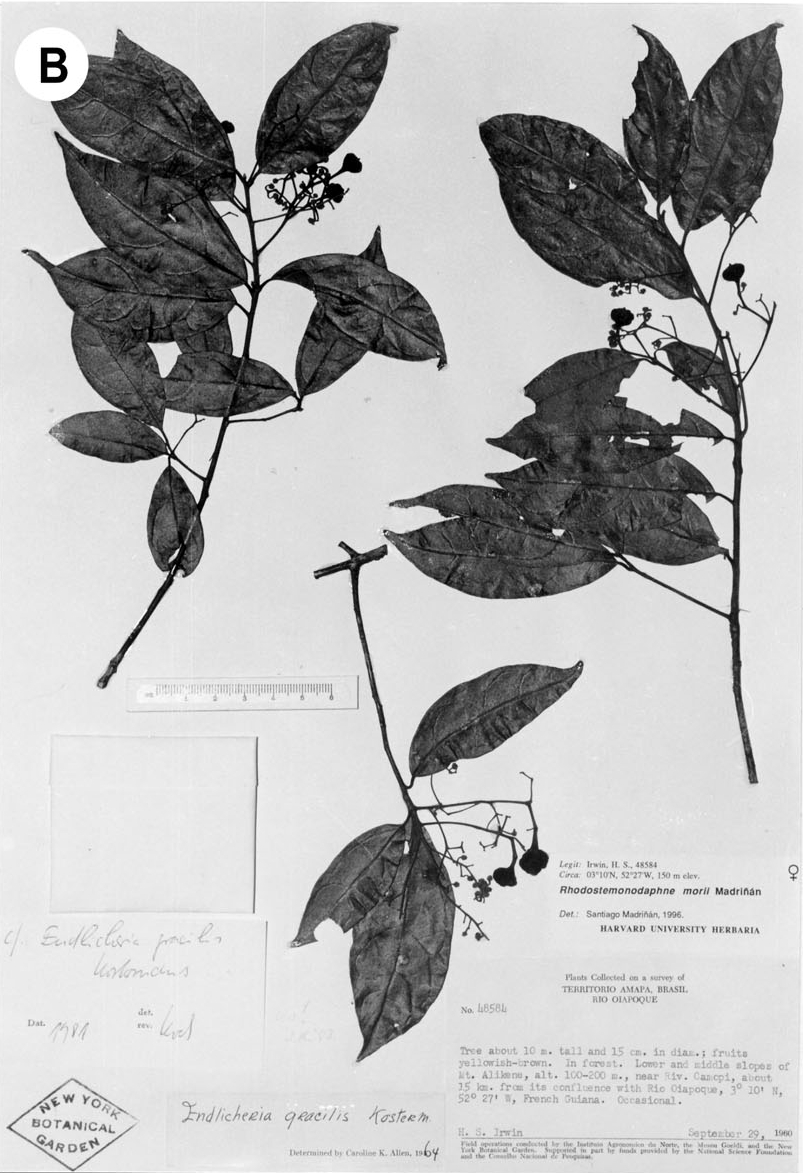
Trees: branches mesotonic, in axils of basal foliage leaves; twigs terete, 1–3 mm diam.; epidermis black; terminal bud plump, ca. 3 X 2 mm; cataphylls caducous; indument puberulous, caducous by next flush, the hairs sparse, up to 0.5 mm long, straight to crisped, erect, brownish. Leaves: petioles slender, (0.1–)0.7–1.2 cm X 0.8–1.6 mm, terete; blades thinly chartaceous, flat, broadly elliptic, (4–)9–17 X 2–5(–7) cm; base obtuse, 50–80°; apex attenuate, 70–90°, ultimately acuminate for up to 1.8(–3.2) cm; margin plane; primary vein above slightly raised and rounded, below prominent; secondary veins (2–)3–5 pairs, often number of secondary veins on the two halves of lamina differing by one, equidistant, brochidodromous, above slightly raised, below prominent, diverging at (45–)55–65°, evenly arching, chordal angle 20–35°, the angle uniform along blade length; tertiary veins above flat to slightly raised, below raised, random-reticulate to scalariform; higher order veins above and below slightly raised; surface above olive-green in young leaves, dark green to black in older leaves, inconspicuously black-dotted, below olive-green, slightly glaucous, the veins brown; indument above absent, the primary and secondary veins tomentose, below puberulous, the hairs isolated, up to 1.5 mm long, curved, erect, yellowish-brown, persisting for at least two flushes. Staminate inflorescences: basitonic to acrotonic, pendulous?, peduncles 4–13 cm long, the hypopodia 1–6 cm X ca. 0.8 mm, branch orders 5(–6), the second-order branches 3–5, clustered apically (scattered), lowest branch up to 4 cm long, color and indument of all axes as on twigs; bracts and bracteoles caducous (not seen). Staminate flowers: pedicels ca. 4.8 X 1 mm, the diameter even throughout; receptacle globose, ca. 1.6 X 4 mm, constricted at the place of tepal inception; tepals chartaceous, ovate, ca. 0.9 X 1.2 mm, at anthesis erect, blackish, adaxially puberulous; stamens of whorls I and II capitate, the anthers trapezoid, ca. 0.8 X 0.64 mm (whorl II slightly smaller), with a few hairs at base, the locelli 2 to 3, apical, in a shallow arch, introrse, the glands absent; whorl III columnar, ca. 1.2 X 0.8 mm, with a few hairs at base, the locelli 4, the upper pair latrorse, the lower pair extrorse, the glands globular, ca. 0.3 mm diam.; whorl IV absent; all stamens reddish; pistillode absent. Pistillate flowers: pistil ca. 1.6 X 1 mm; ovary ovoid, ca. 1 mm long, glabrous. Fruits: pedicels up to 10 X 5 mm, abruptly enlarging to form the cupule; cupule hemispherical, up to 9 X 20 mm, smooth to tuberculate, the margin slightly undulate, tepals persisting; berry elliptic, up to 18 X 15 mm.