Description
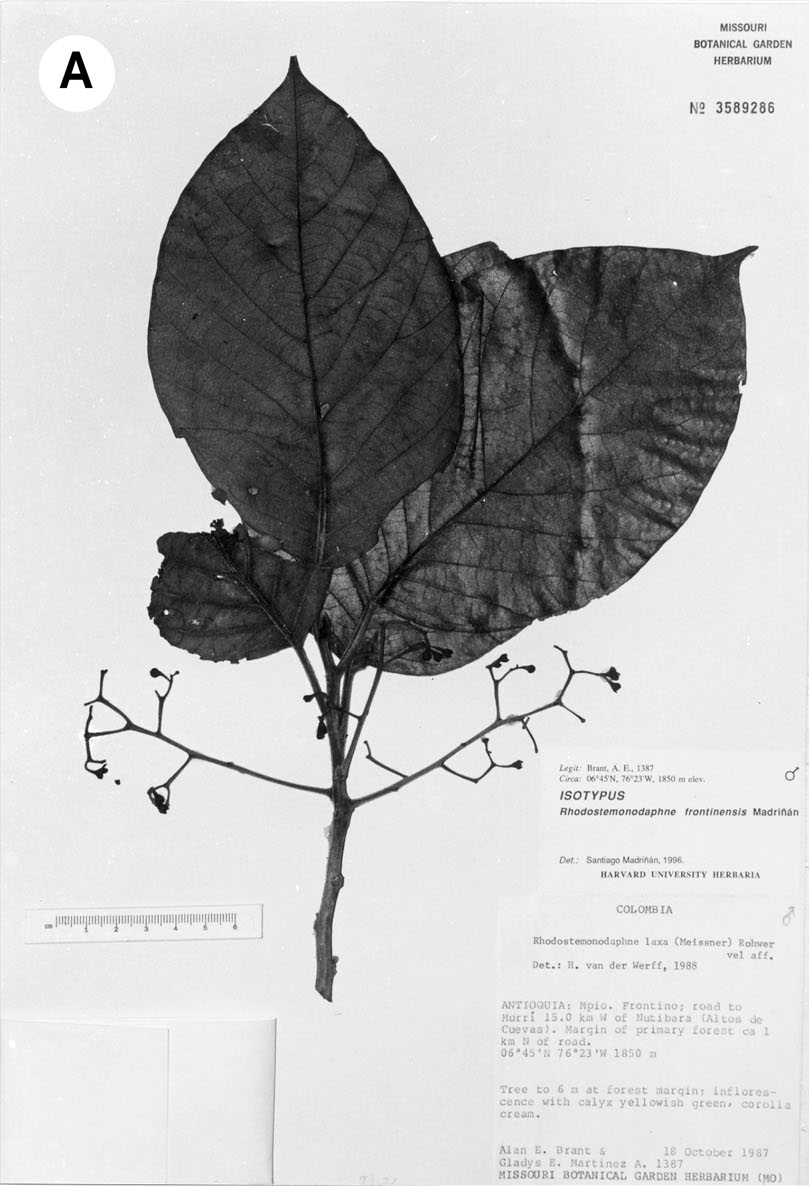
Trees: branches basitonic, in axils of cataphylls; twigs angular, soon becoming terete, 4–5 mm diam.; epidermis brownish to black, barely visible due to indument cover; terminal bud plump, 7–9 X 4–6 mm; cataphylls caducous; indument pubescent, caducous after one flush, the hairs dense, up to 0.8 mm long, straight, erect, yellowish. Leaves: petioles robust, 1.5–2.6 cm X 2.4–3 mm, adaxially flattened; blades chartaceous, flat, broadly elliptic to obovate, 8–20 X 3–12 cm; base obtuse to rounded, minutely decurrent, 80–150°; apex obtuse to rounded, 80–120°, ultimately acuminate for up to 1.2 cm; margin flatmargin plane; primary vein above flat, below prominent; secondary veins 8–10 pairs, equidistant, brochidodromous, above flat, below raised, diverging at 50–60°, abruptly arching near margin (forked), chordal angle ca. 30°, lowest pair more obtuse than rest; tertiary veins above flat, below slightly raised, random-reticulate to scalariform; higher order veins above flat, below slightly raised; surface above olive-green to brown, below dark yellowish-brown; indument above puberulous, primary , the primary and secondary veins tomentose, caducous by next flush? (all leaves of previous flush fallen), below tomentose, the hairs dense, up to 1 mm long, straight to curved, erect, yellowish, denser on the veins, caducous after one flush? Staminate inflorescences: basitonic, erect?, peduncles 5–12 cm long, hypopodiathe hypopodia 1–4 cm X 1.4–2 mm, branch orders 5, second-order , the second-order branches 4–8, dispersed, lowest branch up to 3 cm long, all axes blackish, puberulous; bracts and bracteoles caducous (not seen). Staminate flowers: pedicels ca. 5.6 X 1.2 mm, the diameter gradually increasing apically; receptacle obconical, ca. 2.4 X 3.5 mm; tepals coriaceous, ovate, ca. 2.5 X 1.5 mm, at anthesis erect to spreading, black, adaxially patchy puberulous; stamens of whorls I and II sessile, anther , the antherssessile trapezoid, ca. 1.6 X 1.2 mm (whorl II slightly smaller), glabrous, locelli, the locelli 4 (lowerthe lower pair much larger than upperthe upper pair), apical, in a shallow arch, introrse, glands, the glands absent; whorl III columnar, ca. 1.4 X 0.8 mm, glabrous, locelli, the locelli 4, upperthe upper pair latrorse, lowerthe lower pair extrorse (upperthe upper almost introrse), glands, the glands fused, forming a continuous ring protruding between the outer whorls; whorl IV absent; all stamens yellowish-brown to black; pistillode filiform, ca. 1.2 X 0.4 mm, glabrous. Pistillate flowers and fruits unknown.