Rhodostemonodaphne longipetiolata Madriñán, sp. nov.
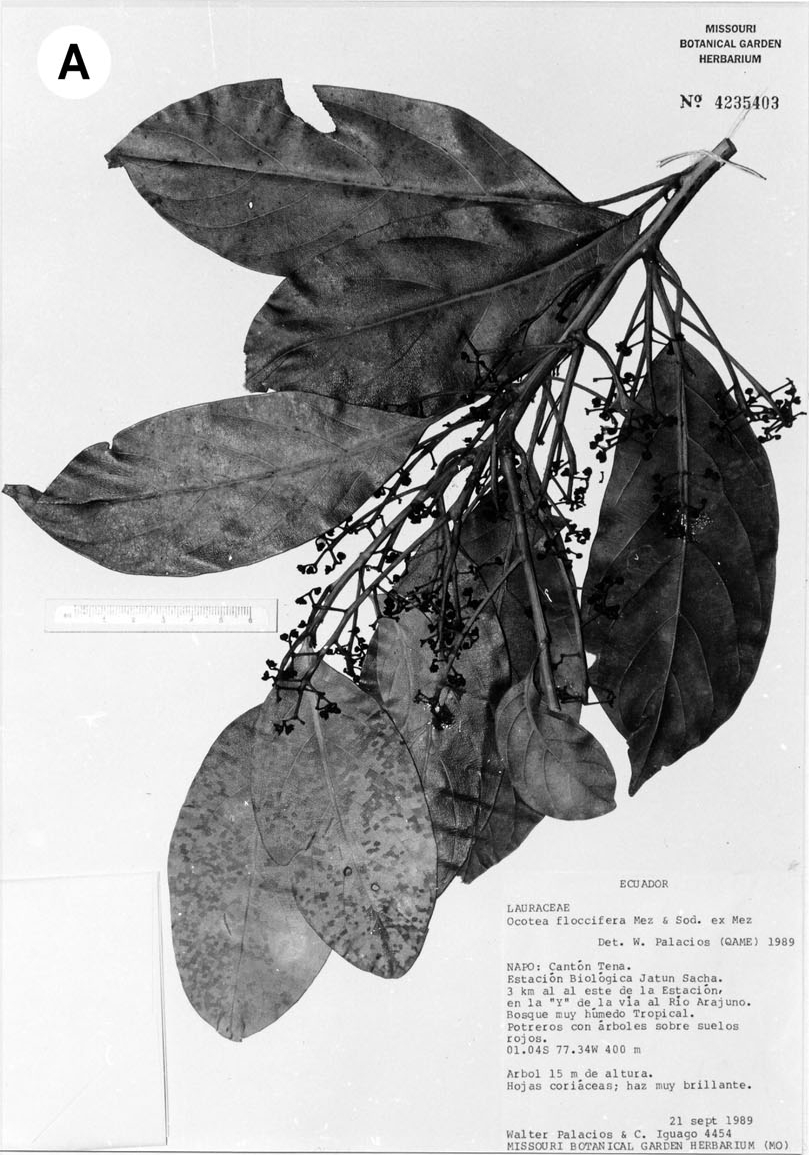
Type. Ecuador. Napo: Estación Biológica Jatun Sacha, 21 Sep 1990 (stam. fl), Palacios & Iguago 4454 (holotype, MO; isotypes, GH, MO).
Antheris monstrosis sed floribus aliter R. kunthianae accedens, ramulis foliisque glabris et petiolis longis bene distincta.
Named for its long petioles. [Lat. longus, + petiolatus, petiolate].
Description
Trees: branching unknown; twigs terete, ca. 5 mm diam.; epidermis yellowish; cataphylls caducous; indument absent. Leaves: petioles robust, (2–)3–4 cm X ca. 2.2 mm, adaxially flattened; blades coriaceous, flat, elliptic, (8–)12–18 X (4–)7–9 cm; base acute, 70–90°; apex obtuse to rounded, 70–120° (acuminate for up to 1 cm); margin plane; primary vein above flat, below raised; secondary veins 6–8 pairs, equidistant, weakly brochidodromous, above flat, below raised, diverging at 40–60°, evenly arching, chordal angle 15–20°, the angle uniform along blade length; tertiary veins above flat, below slightly raised, random-reticulate; higher order veins above and below flat to minutely raised; surface above yellowish-brown, below light yellowish-brown; indument above absent, below glabrous. Staminate inflorescences: basitonic?, erect, peduncles 2–6 cm long, the hypopodia 0.5–3.5 cm X 1.4 mm, branch orders 4, the second-order branches 3–7, dispersed, lowest branch up to ca. 1.5 cm long, color and indument of all axes as on twigs; bracts and bracteoles caducous (not seen). Staminate flowers: pedicels ca. 1.4 X 0.5 mm, the diameter even throughout; receptacle obconical, ca. 2.2 X 1.2 mm; tepals membranaceous, ovate, ca. 1.4 X 1.2 mm, at anthesis spreading?, yellowish-brown to black, adaxially papillose; stamens of whorls I and II, the anthers sessile, chubby, trapezoid, ca. 0.8 X 0.7 mm, whorl I usually doubled and variously fused with stamens of whorl II and III (see discussion), papillose, the locelli 4, in two almost superposed pairs, the upper pair introrse, the lower pair latrorse, the glands absent; whorl III columnar, ca. 1 X 0.8 mm, papillose, the anthers trapezoid, the locelli 4, the upper pair introrse, the lower pair latrorse, the glands absent; whorl IV absent; all stamens reddish; pistillode absent. Pistillate flowers and fruits unknown.
Distribution (Figure 20)
Known only from the type specimen from the Jatun Sacha biological station in Amazonian Ecuador at 400 m elev. The tree was growing in pastures within rain forest on red soils. The flowering specimen was collected in September towards the end of the rainy season.
Discussion
Rhodostemonodaphne longipetiolata can be distinguished vegetatively from any other species by its glabrous, yellowish-drying twigs, long petioles and yellowish–brown-drying, glabrous leaves. Both inflorescence position and flower morphology of the only known specimen seem to be anomalous. The inflorescences arise in clusters of different degrees of elongation from the axils of foliage leaves, each terminated by an apparently functional terminal bud. They are similar to the inflorescences found in various genera of the Laureae (e.g., Lindera, Litsea), where the inflorescences are produced on indeterminate short shoots. This condition is rare in, if not absent from, the Perseeae. Most likely these are the result of expression of axillary buds as vegetative shoots after abortion of the terminal bud, with the production of inflorescences from their onset. All of the various flowers seen had aberrant androecial configuration. In most of the flowers the stamens of whorl I where duplicated resulting in a whorl of 6 stamens. These were situated opposite the outer petal whorl. Each stamen had four locelli. The stamens of whorl II were not different from the “normal” condition found in other species of the genus. Those of whorl III, however, had introrse-latrorse anthers as opposed to the extrorse-latrorse ones found elsewhere in the genus. In a few flowers two and more anthers from the same or different whorls were fused together forming an aberrant double anther. Because only one collection of this species is known, nothing can be said about the constancy of these anomalous forms. Most likely these are the result of some external influence in the development of the inflorescences and flowers–-perhaps linked to the fact that the tree is supposedly a forest tree now living in open pastures. Nevertheless, the vegetative characters used in distinguishing this species are not unusual in the Lauraceae and constitute a unique combination sufficient to distinguish it from any other species in the genus. It resembles R. frontinensis in the shape of the flowers. The stamens are very similar to those of R. kunthiana.