Description
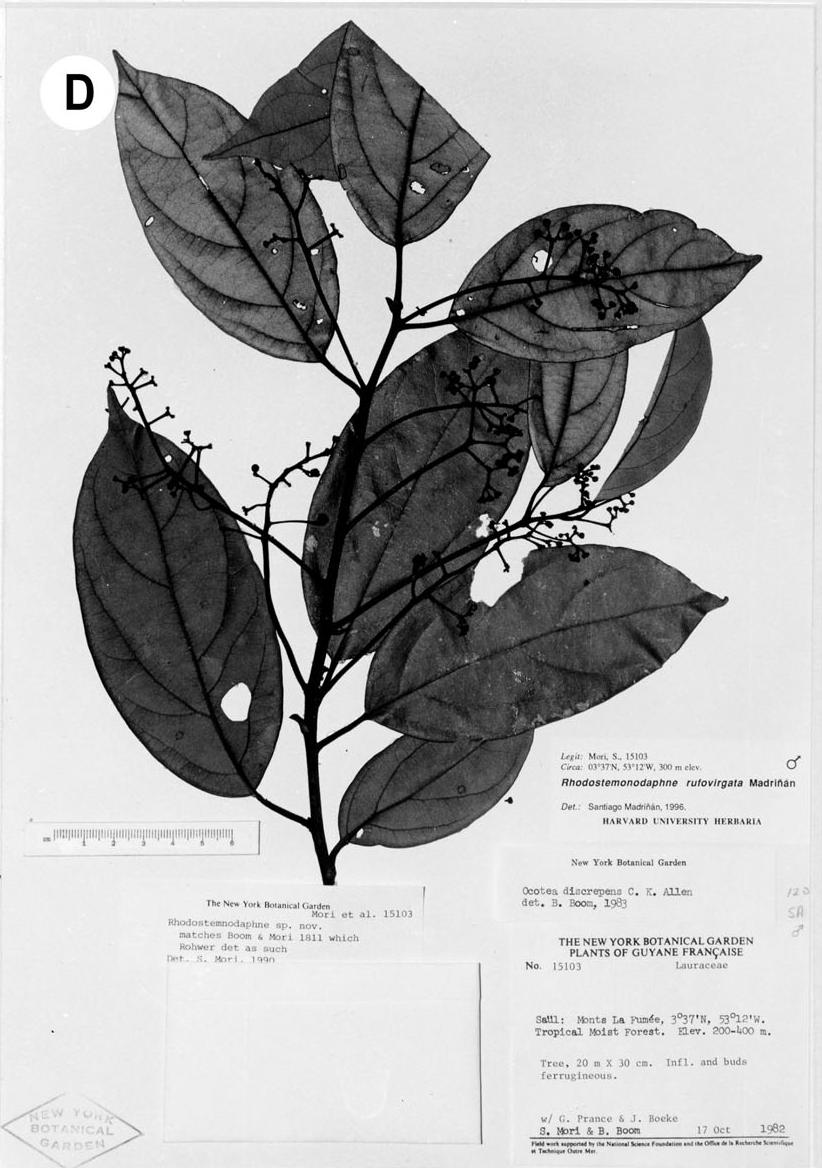
Trees: branches basitonic, in axils of cataphylls, precocious, the whole flush and branches being produced before elongation and lignification; twigs angular, soon becoming terete, 2–4 mm diam.; epidermis black, barely visible due to indument cover; terminal bud plump, ca. 4 X 4 mm; cataphylls persisting on current flush, up to 6 mm long; indument tomentose, persisting for at least two flushes, the hairs dense, up to 0.5 mm long, curved to crisped, erect, reddish. Leaves: petioles slender, 1.3–2.5 cm X 1.3–2 mm, terete; blades chartaceous, flat, narrowly elliptic, (7–)10–18(–22) X 2–6(–9) cm; base acute, 60–100°; apex attenuate, 70–80°, ultimately acuminate for up to 2.2(–3) cm; margin minutely recurved; primary vein above slightly raised and rounded, below raised and longitudinally furrowed; secondary veins 4(–5) pairs, equidistant, eucamptodromous, above flat, below raised, diverging at 40–65°, evenly arching, chordal angle 25–35°, the angle uniform along blade length; tertiary veins above flat, below raised, random-reticulate to scalariform; higher order veins above flat, below slightly raised; surface above reddish-brown in young leaves, olive-green in older leaves, below whitish to cream colored in young leaves, dark brown in older leaves; indument above absent, the primary and secondary veins tomentose, below tomentose, the hairs dense, up to 0.5 mm long, curved to crisped, erect, whitish, denser and reddish on the veins, caducous by next flush. Staminate inflorescences: along whole length of flush, erect, peduncles 6–14 cm long, the hypopodia 3–5 cm X 1.2–1.8 mm, branch orders 5, the second-order branches (3–)7–10, dispersed, lowest branch up to 3 cm long, color and indument of all axes as on twigs; bracts and bracteoles caducous (not seen). Staminate flowers: pedicels ca. 2.4 X 1 mm, the diameter even throughout; receptacle obconical, ca. 1.6 X 3.6 mm; tepals chartaceous, ovate, ca. 1.5 X 1.5 mm (inner whorl slightly smaller), at anthesis erect, reddish-brown, adaxially tomentose; stamens of whorls I and II minutely spathulate to lacking a distinct filament, the anthers reniform, ca. 1 X 0.8 mm, glabrous, the locelli 4, vertically elongate, apical, in a shallow arch, introrse, the glands absent; whorl III columnar, ca. 1.4 X 0.6 mm, glabrous, the locelli 4, the upper pair latrorse, the lower pair extrorse, the glands globular, ca. 0.6 mm diam.; whorl IV absent; all stamens reddish-brown; pistillode absent. Pistillate flowers unknown. Fruits: pedicels up to 20 X 4 mm, gradually enlarging to form the cupule; cupule hemispherical, up to 6 X 1 mm, smooth to wrinkled, the margin straight, tepals caducous; berry elliptic, up to 20 X 15 mm.