Description
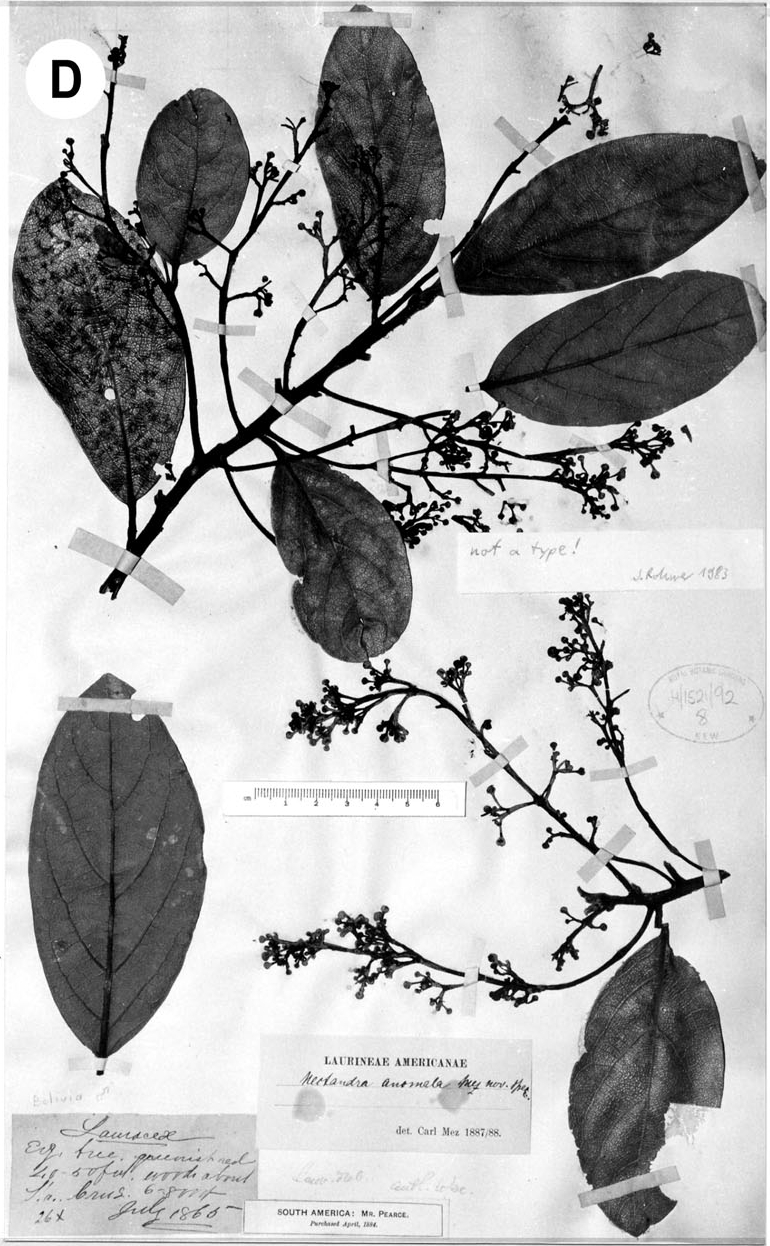
Trees: branching unknown; twigs angular, soon becoming terete, 4–5 mm diam.; epidermis black; terminal bud plump, ca. 1 X 1 mm; cataphylls caducous; indument puberulous, caducous by next flush, the hairs sparse, up to 0.2 mm long, straight to curved, erect, yellowish to reddish. Leaves: petioles robust, 1–1.5 cm X 2–2.5 mm, adaxially flattened; blades coriaceous, flat, elliptic, (6–)8–13 X 3–6 cm; base acute to obtuse, 60–110°; apex obtuse, ca. 100°; margin flatmargin plane; primary vein above flat, below raised; secondary veins 4–6 pairs, equidistant, weakly brochidodromous, above flat, below raised, diverging at 50–55°, evenly arching (forked), chordal angle ca. 20°, angle, the angle uniform along blade length; tertiary veins above flat, below slightly raised, weakly scalariform to random-reticulate; higher order veins above flat, below slightly raised; surface above greenish-brown, the veins darker, below yellowish-green, the veins reddish; indument above puberulous, primary , the primary vein tomentose, caducous by next flush, below puberulous, the hairs isolated, up to 0.3 mm long, straight to curved, erect, golden yellow to reddish, caducous by next flush. Staminate inflorescences: basitonic to mesotonic, pendulous?, peduncles (3–)11–15 cm long, hypopodiathe hypopodia (0.5–)3–4 cm X ca. 2 mm, branch orders 5, second-order , the second-order branches 5–14, dispersed, lowest branch up to ca. 2 cm long, all axes black, indument of all axes as on twigs; bracts and bracteoles caducous (not seen). Staminate flowers: pedicels 10 X 0.6 mm, the diameter even throughout; receptacle obconical, ca. 1.5 X 4.8 mm; tepals membranaceous, ovate, ca. 1.8 X 1.4 mm, at anthesis erect to spreading, reddish to black, adaxially glabrous; stamens of whorls I and II spathulate, chubby, anther , the anthersovate, ca. 0.8 X 1 mm (whorl II slightly smaller), glabrous, locelli, the locelli 4, apical, in a shallow arch, introrse, glands, the glands absent; whorl III columnar, ca. 0.9 X 0.5 mm, glabrous, anther , the antherswith a medial adaxial process, oblong, locelli, the locelli 4, upperthe upper pair latrorse, lowerthe lower pair extrorse, glands, the glands globular, ca. 0.6 mm diam.; whorl IV absent; all stamens reddish; pistillode absent. Pistillate flowers and fruits unknown.