25. Rhodostemonodaphne steyermarkiana
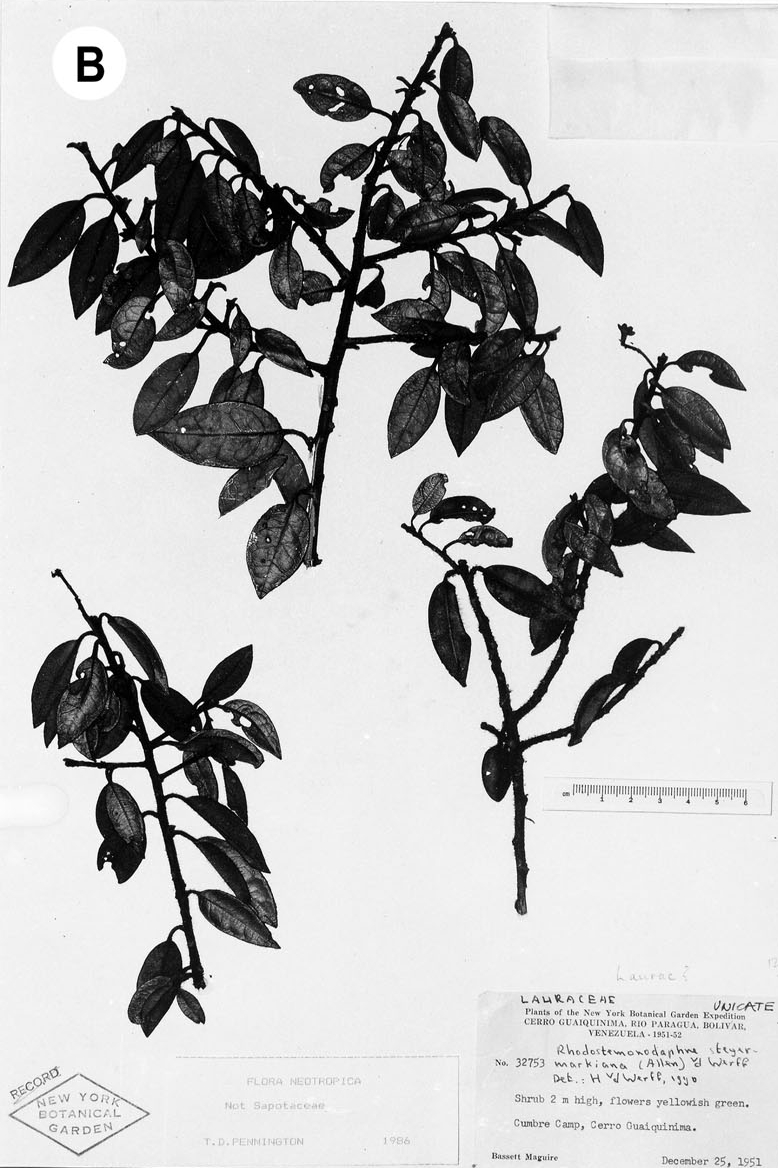
Rhodostemonodaphne steyermarkiana (C. K. Allen) van der Werff
Ann. Missouri Bot. Gard. 76: 474. 1989.
Ocotea steyermarkiana C. K. Allen, Acta Bot. Venez. 2: 216. 1967. Type. Venezuela. Bolívar: Auyán-tepui, summit, 7 May 1964 (pist. fl, fr), Steyermark 93476 (holotype, NY [photo NY neg. 6678]; isotypes, G, K, P, VEN n.v.).
Description
Shrubs: branches basitonic to mesotonic, in axils of cataphylls or basal foliage leaves; twigs terete, 2–5 mm diam.; epidermis black, barely visible due to indument cover; terminal bud plump, ca. 1 X 1 mm; cataphylls caducous; indument pubescent, persisting for at least two flushes, the hairs dense, up to 1.2 mm long, straight to curved, erect, reddish. Leaves: petioles slender, 0.7–1.2 cm X 1–2 mm, terete; blades coriaceous, flat, narrowly to broadly elliptic, 3–7 X 1–5 cm; base obtuse to rounded, 60–140°; apex attenuate to acute, 40–100°, mucronate to acuminate for up to 1 cm; margin plane to revolute; primary vein above flat to impressed, below slightly raised to prominent; secondary veins 4– 7 pairs, equidistant, brochidodromous, above flat to impressed, below slightly raised, diverging at 60–80°, straight to evenly arching, chordal angle 50–60°, the angle uniform along blade length; tertiary veins above and below inconspicuous to flat, random-reticulate; higher order veins above and below inconspicuous; surface above yellow-green, below reddish-brown; indument above absent, below pubescent, the hairs dense, up to 1 mm long, straight to curved, erect, reddish, denser on the veins, persisting for at least two flushes. Staminate inflorescences: along whole length of flush, erect, peduncles 2–6 cm long, the hypopodia 1–3 cm X 1–1.5 mm, branch orders 3, the second-order branches 3–6, dispersed, lowest branch up to 1 cm long, color and indument of all axes as on twigs; bracts persistent or caducous, up to 0.8 mm long, adaxially hairy; bracteoles persistent or caducous, up to 4 mm long, adaxially hairy. Staminate flowers: pedicels ca. 3.2 X 0.8 mm, the diameter even throughout; receptacle flat, ca. 1 X 3.2 mm; tepals membranaceous, obovate, ca. 2.5 X 2 mm, at anthesis spreading to recurved, reddish-brown, adaxially puberulous; stamens of whorls I and II spathulate, the anthers reniform, ca. 1.2 X 1 mm, with a few hairs at base, the locelli 4, apical, in a shallow arch, the upper pair introrse, the lower pair latrorse, the glands absent; whorl III capitate, ca. 1.2 X 0.6 mm, with a few hairs at base, the anthers globose, the locelli 4, the upper pair latrorse, the lower pair extrorse, the glands globular, ca. 0.7 mm diam.; whorl IV absent; all stamens reddish; pistillode absent. Pistillate flowers: pistil ca. 2.5 X 1.8 mm; ovary globose, ca. 1.5 mm long, glabrous. Fruits: pedicels up to 7 X 4 mm, gradually enlarging to form the cupule; cupule trumpet-shaped, up to 10 X 13 mm, smooth to wrinkled, the margin undulate, tepals persisting; berry elliptic, up to 15 X 10 mm.
Field notes
Shrubs up to 2(–4) m tall, already flowering when 1 m tall; leaves above dark green, leaves below pale green. Receptacle brownish-green; tepals yellow-green; stamens/staminodes red?; ovary green. Cupule spreading, coral red; berry pale green with pale spots.
Distribution (Figure 13)
Known from the summits of four sandstone mountains–-Auyán-tepui, Cerro Guaiquinima, Cerro Sarisariñama, and Cerro Jaua–-of the Venezuelan Guayana highlands, at 1400–200 m elev. The vegetation is shrubland and meadow on peat accumulations or rocky soils (Huber, 1995). Apparently with no defined flowering period; the presence of ripe fruits and open flowers at the same time suggests a continuous flowering regime.
Additional specimens examined
Venezuela. Bolívar: Auyán-tepui, summit, 27 May 1986 (stam. fl bud), Holst 3028 (MO); 29 Feb 1988 (pist. fl), Huber 12557 (MO, MYF n.v.); Cerro Guaiquinima, Río Paragua, 25 Dec 1952 (pist. fl), Maguire 32753 (NY); 7 Jan 1952 (st), Maguire 33017 (NY); Auyán-tepui, summit, 10 May 1964 (stam. fl), Steyermark 93595 (NY, VEN n.v.); Meseta de Jáua, Cerro Jáua, summit, 22 Mar 1967 (stam. fl), Steyermark 97853 (NY, US); Meseta de Jáua, Cerro Sarisariñama, summit, 16 Feb 1974 (st), Steyermark et al. 109118 (G, MO).
Discussion
Rhodostemonodaphne steyermarkiana is a very distinct species. Like many upper-montane plant taxa of the Guayana highlands, it is a low shrub with most organs covered with a dense reddish indument that turns black on older branches. It nevertheless is erect, freestanding, and profusely branched, unlike the scandent, little-branched species R. celiana, R. scandens, and R. vinotincta that occur in the same area.
Two specimens from Auyán-tepui, Steyermark 93935 and Steyermark et al. 116012, included in the description of Rhodostemonodaphne steyermarkiana by Allen (1967) are excluded from this species. The leaves of these specimens are characteristically ascending-imbricate, the petioles are shorter, and the venation is slightly acrodromous with the basal-most pair of secondary veins stronger than the rest. The anthers have four locelli arranged in two pairs, indicating a closer affinity to species of Ocotea than to Rhodostemonodaphne. Vegetatively these specimens resemble Ocotea ferruginea (Meissner) Mez, a high-altitude species from the Andes of Peru, or O. rotundata van der Werff, a recently described species from Ecuador–-indeed some specimens of R. steyermarkiana have been determined by Bernardi as O. ferruginea. However, O. ferruginea has short, crisped hairs, as opposed to the long straight to curved ones of these specimens. These specimens may in fact represent a different species from either of the ones mentioned above.