Rhodostemonodaphne peneia Madriñán, sp. nov.
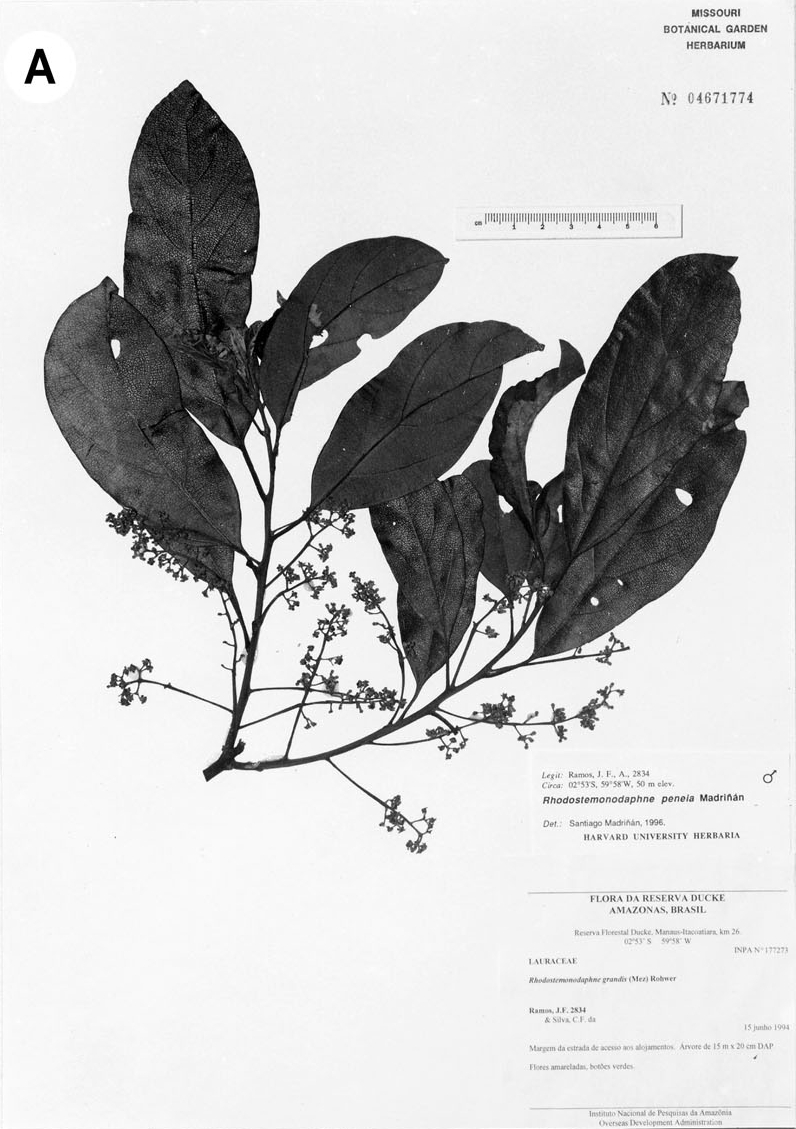
Type. Brazil. Amazonas: Mun. Manaus, Ducke Forest Reserve, 14 Jul 1965 (stam. fl bud), Rodrigues 6976 (holotype, INPA; isotypes, G, HBG).
Rhodostemonodaphne praeclarae et R. saülensi similis, a hac staminibus exsertis, eis verticilli III basi glandulis binis destitutis, ab illa foliorum forma et textura, ab ambabus inflorescentiis floribusque minoribus differt.
Named after the Greek river god Peneus, father of Daphne, in allusion to the riverine habitat of the plant, as also its local name. [Lat. Peneius, belonging to Peneus].
Local name. Louro do baixio.
Description
Trees: branches basitonic, in axils of cataphylls or basal foliage leaves; twigs angular, soon becoming terete, 2–3 mm diam.; epidermis brownish to black; terminal bud slender, ca. 6 X 3 mm; cataphylls caducous; indument sericeous to absent, caducous by next flush, the hairs sparse, up to 0.2 mm long, straight, appressed, ascending, silver. Leaves: petioles slender, 1.3–2(–3.1) cm X 1.2–1.8 mm, adaxially flattened; blades chartaceous, flat, narrowly elliptic, 9–19(–22) X 3–7 cm; base acute, minutely decurrent, 50–100°; apex obtuse, 70–120°, mucronate to acuminate for up to 1.3 cm; margin plane; primary vein above slightly raised, below prominent; secondary veins 5–7(–8) pairs, equidistant, eucamptodromous, above flat, below raised, diverging at 35–55°, evenly arching, chordal angle ca. 20°, the angle uniform along blade length; tertiary veins above flat, below slightly raised, random-reticulate to scalariform; higher order veins above and below slightly raised; surface above and below olive-green to dark brown, inconspicuously black-dotted; indument above absent, below minutely sericeous, the hairs sparse, up to 0.2(–1) mm long, straight, appressed, ascending, yellowish, caducous after one flush. Staminate inflorescences: along whole length of flush, erect?, peduncles 3–11 cm long, the hypopodia 1–5 cm X 0.8–1.2 mm, branch orders 4(–5), the second-order branches (6–)8–9(–11), dispersed, lowest branch up to 1.2(–2.4) cm long, color and indument of all axes as on twigs; bracts and bracteoles caducous (not seen). Staminate flowers: pedicels ca. 2.4 X 0.6 mm, the diameter even throughout; receptacle globose, ca. 1.2 X 2 mm, constricted at the place of tepal inception; tepals membranaceous, obovate, ca. 1.5 X 1 mm (inner whorl slightly smaller), at anthesis recurved, reddish-brown, adaxially puberulous; stamens of whorls I and II spathulate, the anthers reniform, ca. 0.8 X 1 mm (whorl II slightly smaller), with a few hairs at base, the locelli 4, apical, in a shallow arch, introrse, the glands absent; whorl III columnar, ca. 1.4 X 0.6 mm, with a few hairs at base, the anthers globose, the locelli 4, nearly apical, but clearly derived from the upper latrorse pair, and the lower pair extrorse, the glands absent; whorl IV absent; all stamens yellowish; pistillode absent. Pistillate flowers: pistil ca. 2.5 X 1 mm; ovary ovoid, ca. 1.2 mm long, glabrous. Fruits: pedicels up to 15 X 6 mm, abruptly enlarging to form the cupule; cupule hemispherical, up to 25 X 30 mm, smooth to tuberculate, the margin straight, tepals caducous; berry unknown.
Field notes
Trees up to 18(–25) m tall and 25(–40) cm diam., already flowering when 10 m tall; wood yellow. Tepals yellow; stamens/staminodes green.
Distribution (Figure 23)
The Ducke forest reserve near Manaus in the Brazilian state of Amazonas at ca. 100 m elev.; one specimen (Campbell P.22290) from the Rio Trombetas in the state of Pará at 200 m elev. It grows in non-inundated rain forest near streams. In the Manaus area flowering June–September at the end of the rains and beginning of the dry season; in Pará flowering in May, also towards the end of the rainy season.
Additional specimens examined
Brazil. Amazonas: Mun. Manaus, Ducke Forest Reserve, 2 Sep 1968 (pist. fl), Aluísio 122 (HBG, INPA, M, US); 6 Aug 1980 (pist. fl), Kurz B-28-14 (MO); (pist. fl), Kurz B-28-14 (MO); Manaus-Caracarai rd., Km 115, Rio Urubú, 13 Aug 1974 (stam. fl bud), Prance et al. 21642 (HBG X2, K, MO, NY, US, ); Mun. Manaus, Ducke Forest Reserve, 15 Jun 1994 (stam. fl), Ramos & C. F. da Silva 2834 (INPA, MO); 11 Aug 1965 (pist. fl), Rodrigues 7009 (INPA); 23 Mar 1995 (stam. fl), Vicentini & C. F. da Silva 963 (INPA, MO). Pará: Rio Trombetas, Km 109, access rd. from Cachoeria Porteira to Perimetral do Norte, 27 May 1974 (stam. fl), Campbell et al. P.22290 (HBG X2, NY, U).
Discussion
Rhodostemonodaphne peneia is one of the species segregated from the R. grandis-complex (see “The Rhodostemonodaphne grandis-complex” section above). It is vegetatively very similar to R. praeclara with a distribution range that overlaps with that of R. peneia; their membranous tepals, slightly exerted anthers and absence of glands on the stamens of whorl III in both species is also indicative of their close affinity. Rhodostemonodaphne peneia has thinner leaves, although the range of variation in R. praeclara is quite broad, and the inflorescences and flowers of R. peneia are considerably smaller than those of R. praeclara. For other characters used in distinguishing the species of the R. grandis-complex see Table V. The whitish indument on the reproductive parts gives them a quite characteristic greyish appearance, reminiscent of some species of Endlicheria.