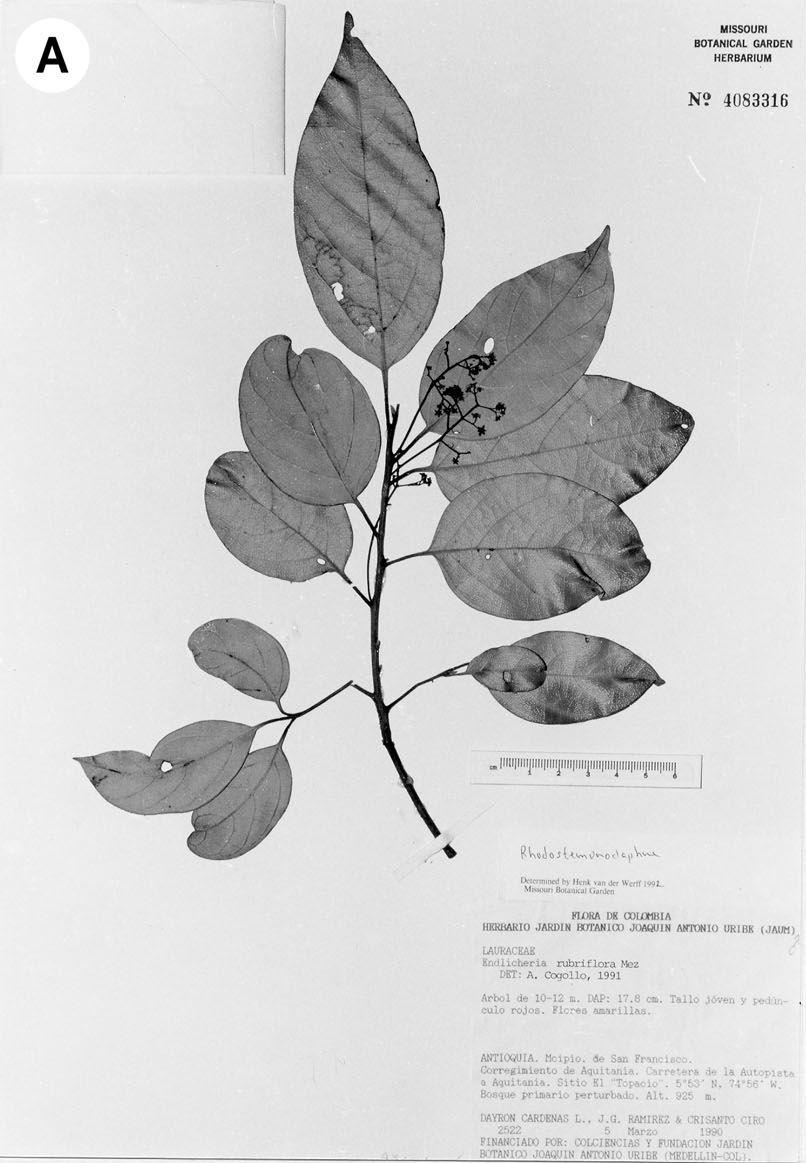
28. Rhodostemonodaphne antioquensis

Rhodostemonodaphne antioquensis Madriñán, sp. nov.


Type. Colombia. Antioquia: Mun. San Francisco, Corr. Aquitania, El Topacio, 5 Mar 1990 (stam. fl), Cardenas, Ramirez  & Ciro 2522 (holotype, COL; isotypes, JAUM, MO).

Ramulis gracilibus et floribus receptaculisque minutis cum R. leptoclada congruens, sed indumento ramulorum haud tomentoso foliisque penninerviis differt.

Named after the Colombian department of Antioquia.

Description

Trees: branches basitonic, in axils of cataphylls or basal foliage leaves; twigs angular, soon becoming terete, 1–3 mm diam.; epidermis yellowish to brownish; terminal bud slender, ca. 5 X 2 mm; cataphylls caducous; indument puberulous to absent, caducous by next flush, the hairs sparse, up to 0.2 mm long, straight, spreading, ascending, yellowish. Leaves: petioles slender, 1–1.5 cm X 1–1.6 mm, adaxially flattened; blades coriaceous, flat, broadly ovate to elliptic, 5–12 X 2–6 cm; base obtuse to rounded, minutely decurrent, 80–120°; apex acute to obtuse, 60–130°, ultimately acuminate for up to 1 cm; margin plane; primary vein above slightly raised, below raised; secondary veins 4–6 pairs, equidistant, eucamptodromous, above slightly raised, below raised, diverging at 50–60°, evenly arching, chordal angle 20–25°, the angle uniform along blade length; tertiary veins above and below slightly raised, random-reticulate; higher order veins above and below slightly raised; surface above shiny yellowish-green, inconspicuously black-dotted, below dull greenish-yellow, minutely but conspicuously black-dotted (blackened subsidiary cells); indument above absent, the primary and secondary veins tomentose, below puberulous, the hairs isolated, up to 0.1 mm long, straight, spreading, ascending, yellowish, caducous by next flush. Staminate inflorescences: mesotonic, erect, peduncles 2–7 cm long, the hypopodia 1–3 cm X 0.8–1 mm, branch orders 5, the second-order branches 4–8, dispersed, lowest branch up to 1.8 cm long, color and indument of all axes as on twigs; bracts and bracteoles caducous (not seen). Staminate flowers: pedicels ca. 4 X 0.3 mm, the diameter even throughout; receptacle obconical, ca. 0.8 X 1.2 mm; tepals membranaceous, ovate, ca. 1.8 X 1.2 mm, at anthesis spreading, yellowish, translucent, adaxially puberulous; stamens of whorls I and II spathulate, the anthers roundish, ca. 1 X 0.8 mm, glabrous, the locelli 4, apical, in a shallow arch, introrse, the glands absent; whorl III capitate, ca. 1.2 X 0.6 mm, glabrous, the anthers globose, the locelli 4, the upper pair latrorse, the lower pair extrorse, the glands globular, ca. 0.5 mm diam.; whorl IV absent; all stamens yellowish-brown; pistillode absent. Pistillate flowers unknown. Fruits: pedicels up to 10 X 2 mm, abruptly enlarging to form the cupule; cupule reflexed, up to 1 X 3 mm, wrinkled, the margin undulate, tepals caducous; berry elliptic, up to 23 X 16 mm.
Field notes

Trees up to 10–12(–25) m tall and 18 cm diam.; outer bark rough, brown; inner bark ca. 1 mm thick, yellow; wood light yellow, wood aromatic; twigs red. Inflorescence axes red; tepals yellow. Cupule red; berry green.

Distribution (Figure 13)

Known from only two collections from the western slopes of the Cordillera Central of the Andes in Colombia at 925 m elev.; in submontane rain forest on limestone.  Flowers in March, towards the end of the dry season, fruits ripe in December.

Additional specimens examined

Colombia. Antioquia: Mun. San Luis, trail to vereda La Josefina, 17 Dec 1982 (fr), Cogollo & Estrada 290 (JAUM).

Discussion

Rhodostemonodaphne antioquiensis has slender, glabrous twigs, and minutely puberulous, penninerved, light yellow–green-drying leaves that are somewhat glaucous adaxially.  It has small flowers with a flat receptacle, similar to those of R. leptoclada, although the latter species has a dense, crisped indument on the twigs and an almost triplinerved venation.

The cupule of the fruiting specimen (Cogollo & Estrada 290) is reflexed, unlike those known in any other species in the genus RhodostemonodaphneCogollo & Estrada 290 lacks flowers, and so its conspecificity with the type of R. antioquiensis is not certain.  Its fruits are very similar to those of Endlicheria rubriflora, a wide ranging species found in Peru, Venezuela, and Colombia, and one specimen of E. rubriflora (Cogollo & Brand 394), was collected in the same general locality of R. antioquiensis.  The leaves of both the type R. antioquiensis and Cogollo & Estrada 290 are smaller, and have longer, thinner petioles than those of E. rubriflora.  In flower, the two species are very different; the tepals of E. rubriflora are glabrous and dry red, and the anthers are two-locellate.  Thus, I am guided by vegetative similarities when designating these specimens as part of a single new species, distinct from either E. rubriflora or R. leptoclada.

Contact | Updated 29.07.2005 | ©2005 Santiago Madriñán