41. Rhodostemonodaphne penduliflora
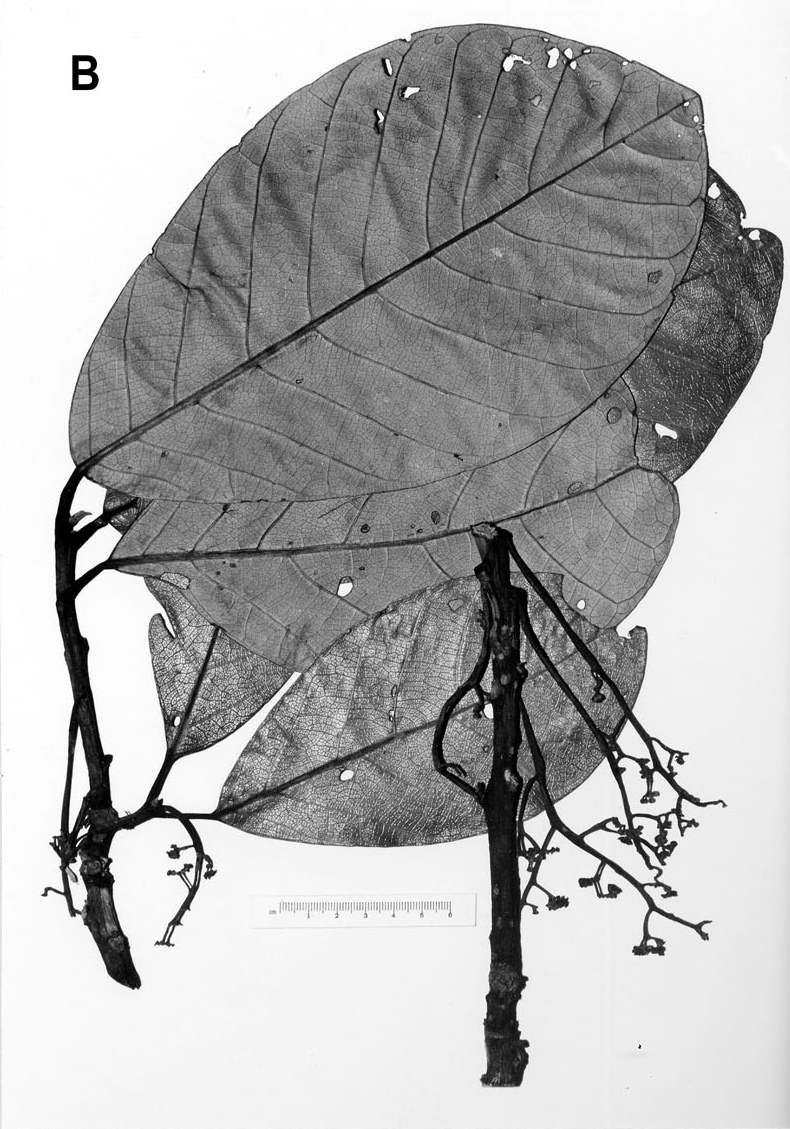
Rhodostemonodaphne penduliflora Madriñán, sp. nov.
Type. Colombia. Cauca: Puerto López de Micay, Río Naya, 1 km upstream from vereda “El Carmen”, 2 Apr 1992 (pist. fl), Cogollo, Devia & Madriñán 5159 (holotype, COL; isotypes, C, F, GH, HBG, JAUM, JBGP, K, MO X2, NY, P, QCA, TULV, U).
Exudato mucilaginoso maxime insignis, a congeneribus inflorescentiis pendulis, staminibus omnibus glanduliferis et eorum verticilli III locellis introrsis divergens.
The specific epithet alludes to the pendulous inflorescences. [Lat. pendulus, pendulous + flos, flower].
Local names. Jigua pava, jigua baboso.
Description
Trees: branches basitonic to mesotonic, in axils of foliage leaves, pseudo-verticillate; twigs angular and remaining so for at least two flushes, ca. 10 mm diam.; epidermis black; terminal bud slender, ca. 6 X 3 mm; cataphylls caducous; indument minutely puberulous, caducous by next flush, the hairs isolated, up to 0.1 mm long, straight, appressed, ascending, inconspicuously golden. Leaves: petioles robust, 1.5–2 cm X 2.5–5.5 mm, adaxially flattened; blades coriaceous, flat, broadly elliptic to obovate, (8–)15–28(–38) X (6–)10–16(–21) cm; base obtuse, 70–110°; apex obtuse to rounded, 110–150°, (mucronate); margin plane; primary vein above flat, below prominent; secondary veins 7– 10 pairs, equidistant, brochidodromous, above raised, below prominent, diverging at 60–70°, straight to evenly arching, occasionally forked, chordal angle ca. 45°, the angle uniform along blade length; tertiary veins above slightly raised, below raised, random-reticulate to scalariform; higher order veins above and below slightly raised; surface above and below yellowish-green to yellowish-brown; indument above and below absent, the veins with isolated, ca. 0.2 mm long, appressed, ascending, yellow hairs. Staminate plant unknown. Pistillate inflorescences: basitonic to mesotonic, pendulous, peduncles 9–27 cm long, the hypopodia 5–12 cm X 1.5–3 mm, branch orders 5, the second-order branches 6–8, dispersed, lowest branch up to 1.5(–4.5) cm long, color and indument of all axes as on twigs; bracts and bracteoles caducous (not seen). Pistillate flowers: pedicels ca. 2.4 X 1.5 mm, the diameter even throughout; receptacle obconical, ca. 1.5 X 3.6 mm; tepals coriaceous, obovate, ca. 3.5 X 3.5 mm (inner whorl slightly smaller), at anthesis recurved, yellowish to reddish-brown, adaxially papillose; staminodes of whorls I and II, the anthers sessile, chubby, broadly elliptical, ca. 1.2 X 2 mm, papillose, the locelli 2–3- 4, apical, in a shallow arch, introrse, the glands minute, ca. 0.6 mm diam.; whorl III columnar, ca. 1 X 3 mm, papillose, the anthers trapezoid, the locelli 1- 2, introrse, the glands laminar, each pair fused and enveloping the staminode on three sides, ca. 0.6 mm diam.; whorl IV absent; all staminodes yellowish to reddish-brown; pistil ca. 1.5 X 1 mm; ovary globose, ca. 1.2 mm long, papillose. Fruits unknown.
Field notes
Trees up to 24 m tall and 30 cm diam.; buttresses ca. 60 cm tall, 30 cm broad; outer bark smooth (with horizontal furrows), shiny black; inner bark ca. 5 mm thick, yellow-brown, with copious clear mucilaginous exudate; light yellow, wood non-aromatic; twigs green; leaves above green, the veins yellow, leaves below light green to yellowish-green. Inflorescence axes reddish; pedicels reddish; tepals yellowish-green; stamens/staminodes green; ovary green, stigma green.
Distribution (Figure 20)
Known only from the type found in the Pacific coast of Colombia, on the border between the Cauca and Valle departments, in the Chocó biogeographic province, at near sea-level. It grows in disturbed forest, on the slope of a hill near a river bank. Flowers in March towards the end of the dry season.
Additional specimens examined
Discussion
Rhodostemonodaphne penduliflora is a very distinct species. Its thick, almost glabrous, black-drying twigs, and large, coriaceous, glabrous, yellow to brown green-drying leaves are unlike those of any other Lauraceae known to me. It is also unique in having features not found in any other member of the genus. These are: copious, clear, mucilaginous exudate from the bark, papillose tepals, staminodes and pistil, paired glands in all three staminal whorls, and introrse staminodes of whorl III. These features are found individually in other genera; the papillose tepals and stamens are a feature common in the genus Nectandra; the presence of glands in all staminal whorls is known only in two small genera, Chlorocardium and Urbanodendron, and one species of Rhodostemonodaphne (R. celiana (C. K. Allen) Rohwer); and the introrse anthers of whorl III–-the norm in the subfamily Laureae sensu Rohwer (1993a)–-are known from only a few species in the Perseeae, the subfamily to which Rhodostemonodaphne belongs (e.g., O. staminea (Grisebach) Mez).
This combination of characters place R. penduliflora in an isolated position within Rhodostemonodaphne. In the meantime, since staminate individuals in which the staminal characters may be better expressed, are unknown, I place this species with the other dioecious species that have four locelli arranged in an arch, i.e., Rhodostemonodaphne. The wood anatomy is nondescript (H. Richter, pers. comm.).