Description
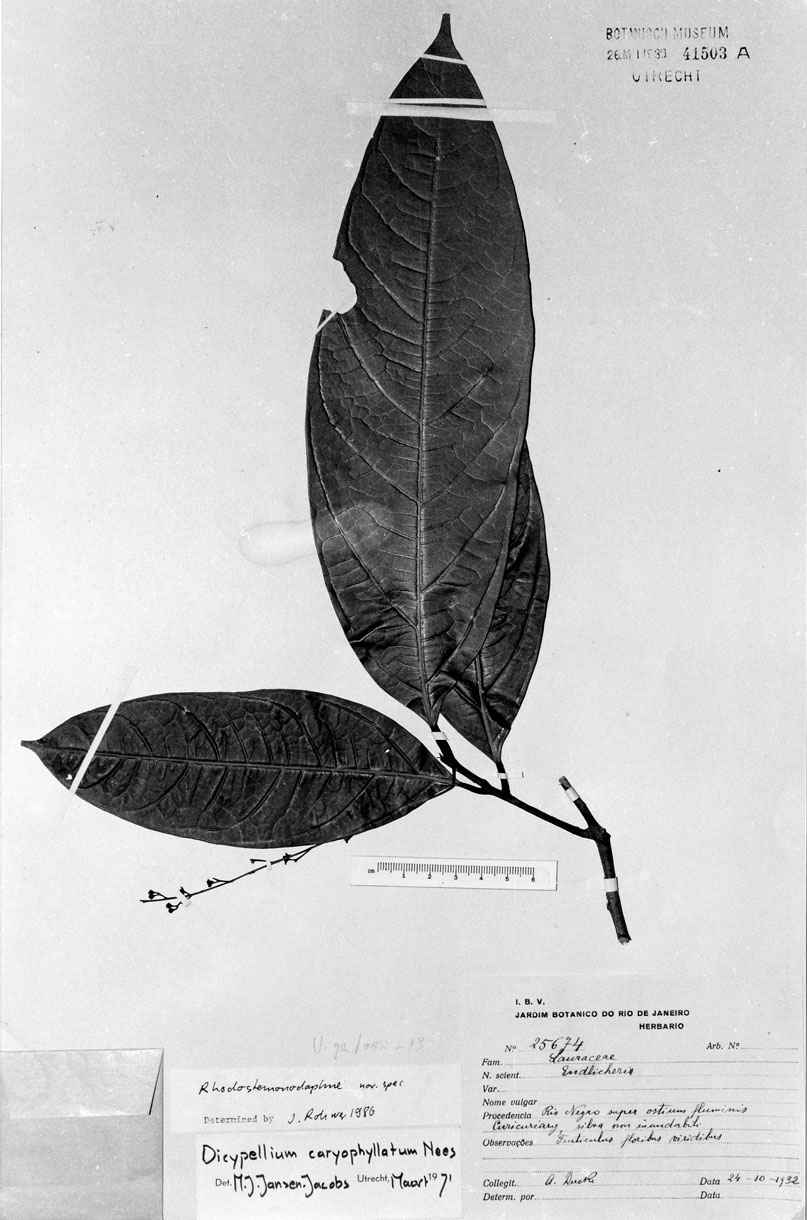
Scandent? shrubs: branching unknown; twigs angular and remaining so for at least two flushes, ca. 3 mm diam.; epidermis yellowish to brownish; terminal bud slender, 4 X 2 mm; cataphylls caducous; indument tomentose, caducous by next flush, the hairs sparse, up to 0.4 mm long, straight, appressed, ascending, yellowish. Leaves: petioles robust, ca. 1.5 cm X 3.5 mm, conspicuously blackened, terete; blades chartaceous, flat to undulate to bullate, narrowly elliptic, 17–31 X 7–9 cm; base acute, ca. 70°; apex acute to obtuse, 70–90°, acuminate for up to 2 cm; margin plane; primary vein above and below raised; secondary veins 7–9 pairs, with distinct intersecondaries, equidistant, brochidodromous, above slightly raised, below raised, diverging at ca. 60°, evenly arching, chordal angle ca. 35°, the angle uniform along blade length; tertiary veins above slightly impressed, below slightly raised, random-reticulate; higher order veins above inconspicuous, below slightly raised; surface above shiny light brownish-green, below greenish-brown; indument above absent, below puberulous, soon glabrescent, the hairs isolated, up to 0.4 mm long, straight, appressed, ascending, yellowish. Staminate plant unknown. Pistillate inflorescences: acrotonic?, pendulous?, peduncles ca. 15 cm long, the hypopodia ca. 5 cm X 1 mm, branch orders 3, the second-order branches 11, dispersed, lowest branch up to ca. 1.7 cm long, color and indument of all axes as on twigs; bracts caducous, up to 3 mm long, adaxially hairy; bracteoles persistent, up to 0.8 mm long, adaxially hairy. Pistillate flowers: pedicels ca. 2.8 X 0.6 mm, the diameter even throughout; receptacle obconical, ca. 1.2 X 2.4 mm; tepals membranaceous, elliptic to oblong, ca. 2 X 1.6 mm, at anthesis spreading, reddish to yellowish-brown, adaxially glabrous; staminodes of whorls I and II, the anthers sessile chubby, trapezoid, ca. 1 X 1.4 mm (whorl II slightly smaller), glabrous, the locelli 4, apical, in a shallow arch, introrse, the glands absent; whorl III columnar, ca. 1.2 X 1.2 mm, glabrous, the anthers trapezoid, the locelli 4, the upper pair latrorse, the lower pair extrorse, the glands (if present) each pair fused to each other and the base of the stamen which is thickened; whorl IV absent; all staminodes reddish-brown to black; pistil ca. 2.5 X 1.6 mm; ovary globose, ca. 1.6 mm long, glabrous. Fruits unknown.