10.
Rhodostemonodaphne macrocalyx
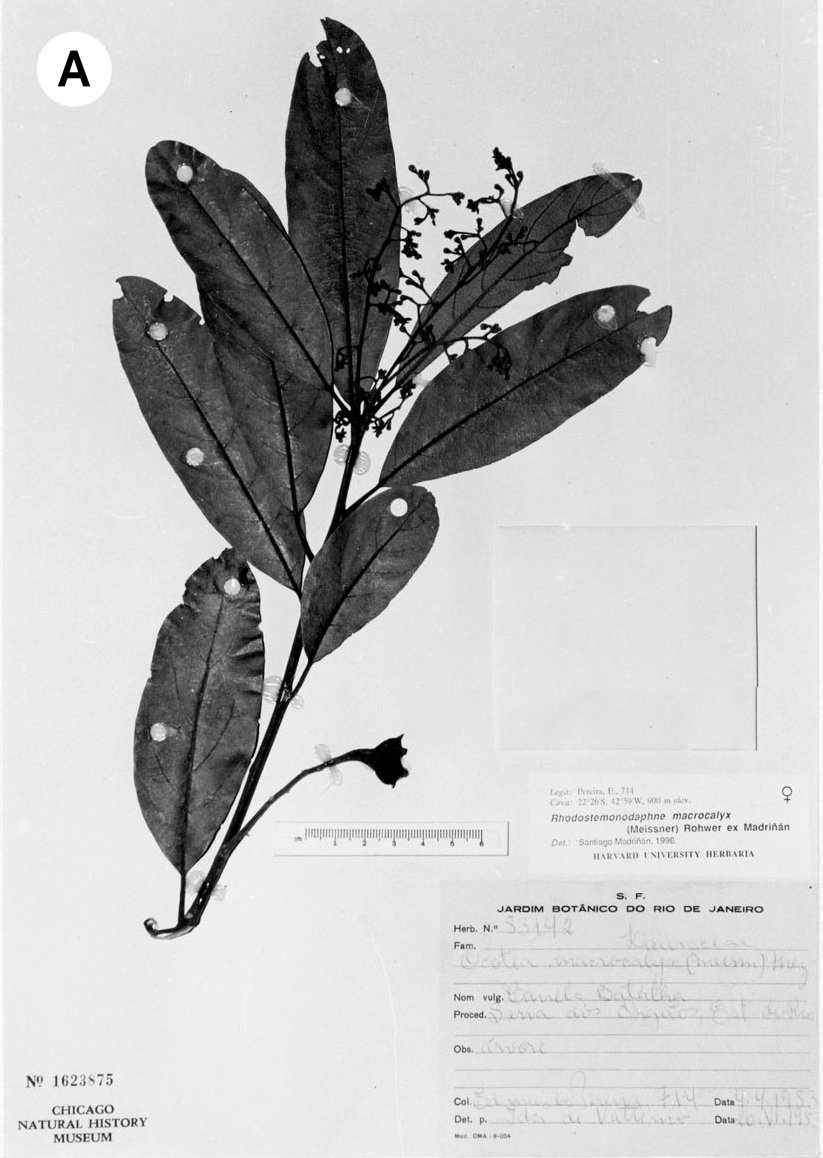
Rhodostemonodaphne macrocalyx (Meissner) Rohwer ex Madriñán, comb. nov.
Goeppertia? macrocalyx Meissner, in A. L. de Candolle, Prodr. 15(1): 174. 1864. Ocotea macrocalyx (Meissner) Mez, Jahrb. Königl. Bot. Gart. Berlin 5: 367. 1889. Type. Brazil. Without locality, 1836 (fr), Sellow s.n. [197 fide Mez] (holotype, B [photos: B neg. 5268, NY neg. 8382, F neg. 3678]; isotypes, F [frag. ex B], HBG [frag. ex B]).
Local names. Canelo batallia, canela cedro.
Description
Trees: branches basitonic, in axils of cataphylls or basal foliage leaves; twigs terete, 2–4 mm diam.; epidermis brownish to black; terminal bud plump, ca. 1 X 1 mm; cataphylls caducous; indument tomentose, caducous by next flush, the hairs dense, up to 1 mm long, curved to crisped, erect, brownish. Leaves: petioles slender, 1–2.5 cm X 1.4–2.4 mm, adaxially flattened; blades chartaceous, flat, narrowly elliptic, sometimes lobed!, (6–)7–13(–23) X (1–)2–4(–8) cm; base acute to obtuse, minutely decurrent, 40–60(–100)°; apex attenuate to acute to rounded, 30–50(–110)°, ultimately acuminate for up to 2.5 cm; margin plane; primary vein above flat to slightly raised, below prominent; secondary veins (4–)6(–9) pairs, equidistant, eucamptodromous, above flat to slightly raised, below prominent, diverging at 40–60°, evenly arching (forked), chordal angle 20–30°, the angle uniform along blade length; tertiary veins slightly raised, below raised, random-reticulate to scalariform; higher order veins above slightly raised, below raised; surface above green to brown, below light brown, often whitish; indument above absent, the primary vein tomentose, below tomentose, the hairs isolated, up to 1 mm long, curved, erect, yellowish to yellowish-brown, denser on the veins (with inconspicuous hair domatia), persisting for at least two flushes. Staminate inflorescences: mesotonic to acrotonic, erect, peduncles 2–16 cm long, the hypopodia 1–5 cm X 0.5–2 mm, branch orders 2–5(–8), the second-order branches 4–10, dispersed, lowest branch up to 2(–5.5) cm long, color and indument of all axes as on twigs; bracts soon caducous, up to 3.5 mm long, adaxially glabrous; bracteoles soon caducous, up to 1.5 mm long, adaxially hairy. Staminate flowers: pedicels ca. 5.6 X 0.8 mm, the diameter even throughout; receptacle obconical, ca. 2 X 2.4 mm; tepals coriaceous, elliptic to ovate, ca. 3 X 2.5 mm, at anthesis spreading to recurved, reddish to salmon to brown, translucent, adaxially puberulous; stamens of whorls I and II filiform, the anthers oblong inflexed, ca. 1.8 X 0.44 mm, glabrous, the locelli 4, in two almost superposed pairs, introrse, the glands absent; whorl III filiform, ca. 1.8 X 0.4 mm, glabrous, the anthers oblong, the locelli 4, the upper pair latrorse, the lower pair extrorse, the glands globular to folded, ca. 1 mm diam. (protruding beyond outer whorls); whorl IV absent; all stamens reddish; pistillode absent. Pistillate flowers: pistil ca. 2.4 X 1 mm; ovary ovoid, ca. 1.5 mm long, glabrous. Fruits: pedicels up to 18 X 3 mm, gradually enlarging to form the cupule; cupule trumpet-shaped, up to 13 X 17 mm, smooth, the margin undulate to straight, tepals persisting to caducous; berry elliptic, up to 23 X 14 mm.
Field notes
Trees up to 15 m tall and 25 cm diam., already flowering when 6 m tall. Tepals cream to greenish. Berry greenish.
Distribution (Figure 7)
This species is the most southerly member of the genus. It is found on the Atlantic coast from Bahia to Paraná at 25° S. The plants grow in coastal forest and adjacent mountains from sea level to 800 m elev. (occasionally reaching ca. 1500 m in the Mantiqueira range). The bulk of the flowering specimens were collected December–April, during the main months of the rainy season, with a few flowering collections in the northern part of the range made as late (early) as September. The few fruiting specimens have been collected in June–July, at the beginning of the dry season.
Additional specimens examined
Brazil.Bahia: Prado-Itamaraju rd., ca. 65 km NW of Prado, 18 Sep 1978 (stam. fl), Mori et al. 10669 (HBG, K, NY); Guaratinga, Eunápolis, Itabela, 4 Jul 1970 (stam. fl), T. S. dos Santos 885 (HBG, SP). Espírito Santo: Santa Teresa, Estação Biológica da Caixa D’agua, 14 Aug 1984 (fr), Hoffmann 178 (MO). Paraná: Rio da Divisa, Mun. Guaratuba, 14 Mar 1962 (pist. fl), Hatschbach 8936 (F, HBG, MO, S, SP); Serrinha, Mun. Guaraqueçaba, 11 Jan 1968 (pist. fl), Hatschbach 18272 (AAU, B, C, F X2, G, INPA, K, MO, NY X2, RB, US); Cacatú, Mun. Antonina, 29 Jan 1968 (stam. fl), Hatschbach 18487 (NY X2, S, US); Serra de Araraquara, Mun. Guaratuba, 15 Mar 1696 (stam. fl), Hatschbach 21269 (C, MO); Bocaiúva do Sul, Parque das Lauráceas, 24 Jan 1990 (stam. fl), Hatschbach & Cordeiro 53737 (MO); 28 Dec 1994 (stam. fl), Hatschbach & J. M. Silva 61392 (MO). Rio de Janeiro: Sumaré-Tijuca rd., summit of Serra da Carioca, 1 Feb 1929 (stam. fl), Bandeira s.n. (F X2, G, RB); Rio de Janeiro (pist. fl), Binot 110 (M); Tijuca (stam. fl), Boissier 12 (G); Vista Chinesa rd., Gávea, 15 May 1929 (stam. fl), Duarte & Bandeira 263 (F, RB X2); Rio de Janeiro, Redentor rd., 10 Jul 1961 (stam. fl), Duarte 5605 (F, INPA, K, RB); Petrópolis (st), Glaziou 822 (C); Rio de Janeiro (stam. fl), Glaziou 824 (C, K, NY); (pist. fl), Glaziou 1290 (C, K); Petrópolis, 2 Feb 1880 (pist. fl), Glaziou 12119 (A, B [photo B neg. 7714], BM, C X2, F X3, G, K, NY, ); 20 Apr 1880 (pist. fl), Glaziou 12128 (A, B [photo B neg. 7713], C, F, G, K, NY X2); 19 Jan 1884 (stam. fl), Glaziou 15367 (C, G, K, NY); Petrópolis, Serra dos Orgãos, 7 Apr 1891 (stam. fl), Glaziou 17742 (B, C X2, F, G, K X2, US); Serra de Macaé (stam. fl), Glaziou 18454 (A, BM, C, G, K, NY); Tijuca? (fr), Graham s.n. (K); Gravatá, Pai Ricardo, 20 Dec 1926 (stam. fl), Horto-Florestal (RB)102874 (F, NY); 30 Dec 1927 (stam. fl), ), Horto-Florestal (RB)110103 (F, NY); Vista Chinesa rd., 1 Jul 1958 (fr), Liene et al. 3970 (HBG); Rio de Janeiro, Corcovado (st), Nadeaud s.n. (P); Sumaré-Tijuca rd., summit of Serra da Carioca, 22 Jun 1978 (pist. fl), Occhioni 8580 (B); Petrópolis, Serra dos Orgãos, 4 Apr 1953 (pist. fl, fr), E. Pereira 714 (F, RB); Sumaré, 23 Feb 1959 (stam. fl), E. Pereira & Duarte 4481 (HB); 24 Feb 1959 (pist. fl), E. Pereira & Duarte 4520 (HB, NY); Rio de Janeiro, Redentor rd. (stam. fl), E. Pereira & Duarte 4535 (B, F, HB, RB); (pist. fl), 4536 (HB); “Brasília” [Esperança fide Mez] (stam. fl), Riedel s.n. [770 fide Mez] (B, G X2, K); Teresópolis, Fazenda Boa Fé, Picada Davis, 9 Apr 1943 (stam. fl), Velloso 382 (HBG). Sáo Paulo: Serra da Mantiqueira, 16 Mar 1939 (stam. fl), M. Kuhlmann & Gehrt (SP)40043 (G).
Discussion
Rhodostemonodaphne macrocalyx is characterized by its flowers which have elongated, filiform stamens, inflexed anthers with introrse to latrorse dehiscence, and very large glands of whorl III which protrude beyond the outer whorls. In all these characters it resembles various species of the genus Pleurothyrium. However, it appears to be most closely related to R. capixabensis also from the Atlantic coast of Brazil (see Table VIII).
There is a marked north-south variation gradient, most pronounced on the southern extratropical extreme. In the northernmost part of the range, two collections from the state of Bahia (Mori et al. 10669 and T. S. dosSantos 885), have larger, narrowly elliptic, long-acuminate leaves, with few, branched secondary veins, and profusely branched inflorescences, allowing the distinction with the sympatric R. capixabensis (see discussion under R. capixabensis). The majority of the specimens examined come from the state of Rio de Janeiro. In general they have small, elliptic to narrowly ovate, or attenuate leaves, and inflorescences with few orders of branching. The only known specimen from the Mantiqueira range in the state of São Paulo is indistinguishable from the collections from Rio de Janeiro. Further south the various collections by Hatschbach differ from the rest in a number of characters. Hatschbach 8936, has large long-acuminate leaves and much-branched inflorescences similar to the specimens from the northern extreme of the range. Two inland specimens from Bocaiúva do Sul (Hatschbach & Cordeiro 53737 and Hatschbach & J. M. Silva 61392), have smaller leaves with a high number of secondary veins (up to 8).
Three coastal specimens collected on mountain slopes (Hatschbach 18272, 18487, and 21269) differ from the rest in having widely elliptic leaves, with more obtuse bases and apices, and conspicuously branched secondary veins. The collections are unusual in that most of the leaves show various degrees of lobing, associated with the forked secondaries, ranging from a slight apical asymmetry to one conspicuous lateral lobe. This lobing of the leaves is only known in two distant genera of Lauraceae (i.e., Sassafras and Lindera). These specimens may represent a separate entity from the core of R. macrocalyx. One collection from Espírito Santo, I. A. Silva 345, is here postulated as a hybrid between R. capixabensis and R. macrocalyx; see discussion under R. capixabensis.
Vegetatively R. macrocalyx resembles Endlicheria paniculata (Sprengel) Macbride, a species inhabiting the same general area. The indument and leaf shape and size are very similar. They can be distinguished by the fewer, more acute secondary veins and the two-locellate anthers of E. paniculata.
Mez (1889) included
Goeppertia reflectens (Nees) Meissner in the synonymy of
Ocotea macrocalyx (Meissner) Mez; Meissner had misidentified
Graham s.n. as that species. However,
Graham s.n. belongs to
R. macrocalyx. An invalid name,
“Mespilodaphne floribunda Meissner,” another synonym cited by Mez in the same work and attributed to manuscript annotations in various herbaria, can be referred to the specimen
Riedel s.n (given the number
770 by Mez) which I have seen annotated by Meissner as such (cf. G [2 sheets], and K); it belongs to
R. macrocalyx.