24. Rhodostemonodaphne celiana
Rhodostemonodaphne celiana (C. K. Allen) Rohwer
Mitt. Inst. Allg. Bot. Hamb. 20: 85. 1986.
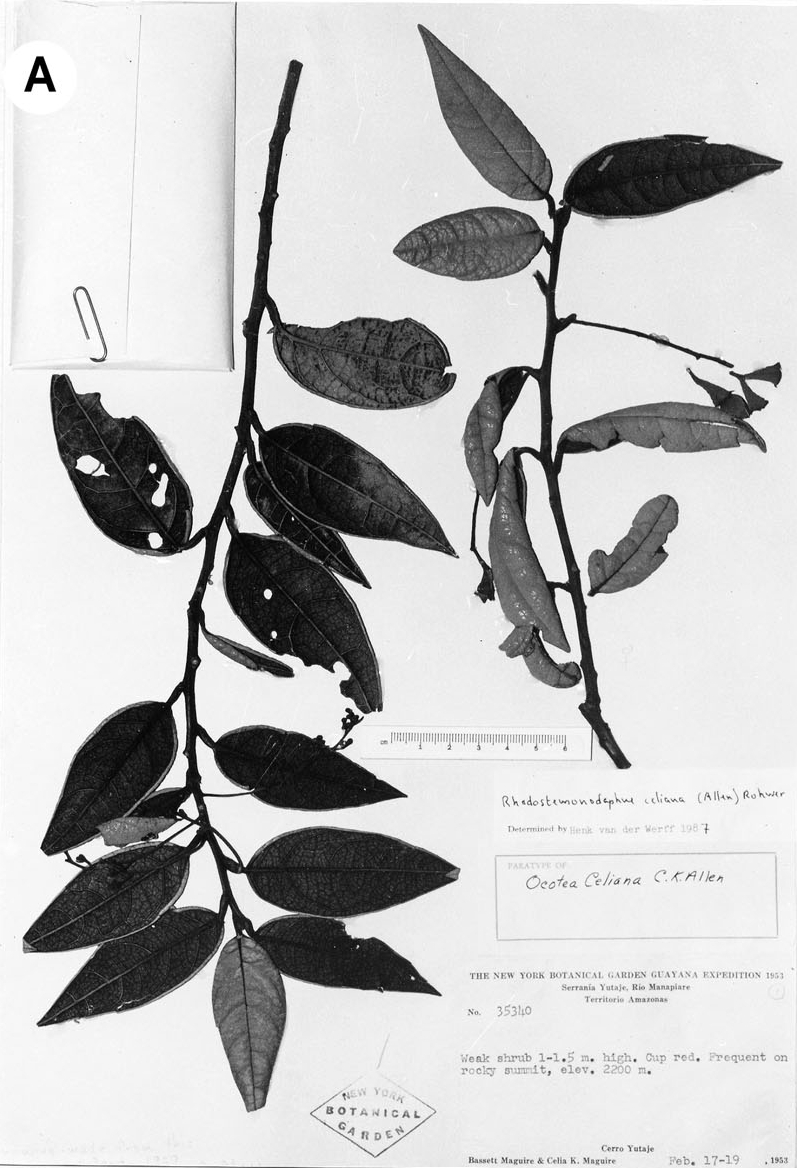
Ocotea celiana C. K. Allen, Mem. New York Bot. Gard. 10(5): 106, fig. 57. 1964. Type. Venezuela. Amazonas: Atures, Serranía Yutajé, Cerro Coro-Coro, Río Manapiaré, 2 Mar 1953 (pist. fl, fr), Maguire & Maguire 35450 (lectotype here designated, NY [photo NY neg. 5938]).
Description
Scandent shrubs: with long, slender and sparsely branched shoots; branches basitonic to mesotonic, in axils of basal foliage leaves; twigs terete, 2–4 mm diam.; epidermis brownish to black, barely visible due to indument cover; terminal bud plump, ca. 4 X 2 mm; cataphylls caducous; indument pubescent, persisting for at least two flushes, the hairs dense, up to 1 mm long, curved to crisped, erect, reddish. Leaves: petioles pulvinate, 0.5–1.5 cm X 1–2.5 mm, terete; blades coriaceous, flat to undulate to bullate, narrowly ovate to elliptic, 3–11 X 1–5 cm; base rounded to cordate, 90–190°; apex attenuate to acute, 40–70°, ultimately acuminate for up to 1.5 cm; margin recurved to revolute; primary vein above slightly raised, below prominent; secondary veins 8–11 pairs indistinguishable from tertiary veins towards the apex, equidistant to further apart towards the apex, brochidodromous, above impressed, below prominent, diverging at 60–70°, evenly arching, chordal angle 30–65°, the angle increasing apically; tertiary veins above slightly impressed, below raised, random-reticulate; higher order veins above slightly impressed, below slightly raised; surface above yellowish-green to greenish-brown, below reddish-brown to reddish-black; indument above absent, the primary vein tomentose, below pubescent, the hairs dense, up to 0.6 mm long, straight to curved, erect, reddish, persisting for at least two flushes. Staminate inflorescences: basitonic to mesotonic, pendulous, peduncles 4–16 cm long, the hypopodia 2–7 cm X 0.5–1 mm, branch orders 4, the second-order branches 4–7, dispersed, lowest branch up to 1(–3) cm long, color and indument of all axes as on twigs; bracts caducous (not seen); bracteoles persistent or caducous, up to 2 mm long, adaxially hairy. Staminate flowers: pedicels ca. 3.2 X 0.8 mm, the diameter even throughout; receptacle flat, ca. 1.2 X 2.2 mm; tepals membranaceous, elliptic, ca. 3 X 2.4 mm, at anthesis erect to spreading, reddish-brown, adaxially tomentose; stamens of whorls I and II, the anthers sessile, laminar, obovate, ca. 1.4 X 1.2 mm, with a few hairs at base, the locelli 4, apical, in a shallow arch, introrse, the glands globular to flattened, ca. 0.3 mm diam.; whorl III columnar, ca. 1.4 X 0.6 mm, with a few hairs at base, the locelli 4, the upper pair latrorse, the lower pair extrorse, the glands globular, ca. 0.6 mm diam.; whorl IV staminodial, columnar; all stamens reddish-yellow; pistillode absent. Pistillate flowers: pistil ca. 2.5 X 1.4 mm; ovary globose, ca. 1.6 mm long, glabrous (with a few hairs at base). Fruits: pedicels up to 10 X 3 mm, gradually enlarging to form the cupule; cupule trumpet-shaped, up to 4 X 7 mm, smooth, the margin undulate, tepals persisting; berry elliptic, up to 13 X 9 mm.
Field notes
Scandent shrubs, sprawling over neighboring vegetation up to 2(–4) m tall; wood white; leaves above dull to dark green. Receptacle greenish-brown?; tepals yellowish; stamens/staminodes greenish-white. Cupule red.
Distribution (Figure 13)
Endemic to the Yutajé-Coro-Coro massif, a tepui (sandstone mountain) reaching up to 2400 m., on the western edge of the Venezuelan Guayana. This species grows on the rocky summits and slopes between 1200–2200 m, in dense, low (ca. 6 m tall), wet, evergreen, upper-montane forest (Huber, 1995). All collections (flowering and fruiting) have been made in February and March, at the beginning of the rainy season.
Additional specimens examined
Venezuela. Amazonas: Atures, Serranía Yutajé, Río Coro Coro valley, 3 Mar 1987 (stam. fl), Holst & Liesner 3287 (MO, NY); Atures, Serranía Yutajé, Río Coro-Coro valley, 6 Mar 1987 (stam. fl), Holst & Liesner 3324 (F, MO, U, US); Atures, Serranía Yutajé, summit, E sector, 21 Mar 1988 (stam. fl), Huber 12603 (MO); Atures, Sarranía de Yutajé, Cerro Yutajé, Río Manapiare, 17 Feb 1953 (stam. fl), Maguire & Maguire 35320 (NY); (pist. fl), 35320[A] (NY, W); Atures, Serranía Yutajé, Cerro Coro-Coro, Río Manapiaré, 2 Mar 1953 (stam. fl), ), Maguire & Maguire 35450 [A] (F [photo F neg. 58176], US); Atures, Sarranía de Yutajé, Cerro Yutajé, Río Manapiare, 17 Feb 1953 (pist. fl), ), Maguire & Maguire 35290 (G, GH, NY); (pist. fl, fr), ), Maguire & Maguire 35340 (FHO, NY).
Discussion
This is a most distinct species both in terms of its vegetative morphology and flower structure. It is a low, scandent, shrub, with thin, long, little-branched stems that grow supported by adjacent vegetation. This growth habit is shared with a few other species in the genus. The reddish pubescence on the twigs, inflorescences and undersides of leaves is also found in a few other species, generally in those restricted to the sandstone mountains of the Guayana highlands. Its hard, brittle, undulate to bullate leaves with recurved margins, and anatomical details are also quite characteristic. Its flowers are unlike any other in the genus, apart from those of R. penduliflora; the stamens of all three outer whorls have a pair of glands at the base.
Allen (1964) stated that the outer two whorls of stamens in the staminate individuals seemed sterile, thus resembling the genus Dicypellium; however, in Dicypellium the flowers are hermaphroditic. In the specimens examined, some of the staminate flowers had stamens of the outer whorls with incompletely developed anthers, but the great majority of flowers seen had fertile anthers in all three outer whorls. Allen also mentions that all stamens having glands is akin to the condition found in the genus Pleurothyrium. In fact, Pleurothyrium has glands only on the anthers of whorl III, as in most other Lauraceae, but they are often greatly enlarged and sometimes fuse to form a continuous ring (see Rohwer, 1986, and van der Werff, 1993). Urbanodendron does have glands on all staminal whorls, and the anthers are mainly four-locellate, but the flowers are hermaphroditic.
Allen cited Maguire & Maguire 35450 as the type of Ocotea celiana, and noted details of the staminate and pistillate flowers, and fruits. Both twigs on the sheet Maguire & Maguire 35450 at NY are from pistillate individuals; the one on the left has flowers, and the one on the right an infructescence with a fruit (the fruit is now included in the envelope, but in a NY photograph of the specimen made some years ago it is attached!). No isotypes were designated, but I was able to examine two duplicates with the same number from F and US. Both are staminate individuals. It is probable that the type collection is a mixed collection, and that the species was described prior to distribution of the duplicates. Allen cited the holotype as having staminate flowers and fruits; Maguire & Maguire 35450 at NY now consists of only pistillate individual(s?). Lectotypification is needed because of the two elements in Maguire & Maguire 35450 (as mentioned in the discussion of R. capixabensis, it is unlikely that one individual will have both staminate and pistillate flowers); I designate the pistillate element as the holotype. I have added the suffix A to the collection number to represent the staminate duplicates at F and US.
One other collection (Maguire & Maguire 35320) is also mixed. The sheet at NY has both staminate and pistillate individuals, while the sheet at W has only one staminate twig. I have added the suffixes A & B to the number to refer to the staminate and pistillate elements.