9. Rhodostemonodaphne anomala
Rhodostemonodaphne anomala (Mez) Rohwer
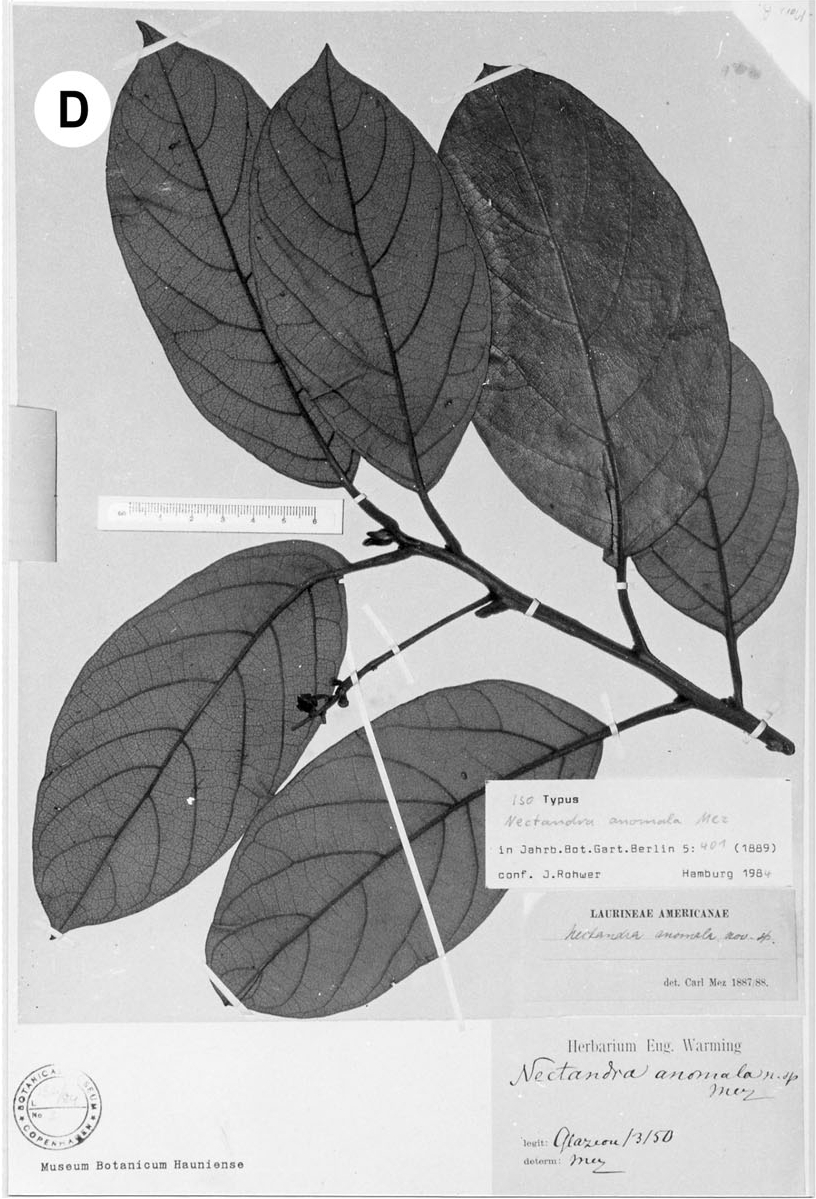
Mitt. Inst. Allg. Bot. Hamb. 20: 83. 1986. Nectandra anomala Mez, Jahrb. Konigl.Königl. Bot. Gart. Berlin 5: 401. 1889. Type. Brazil. Rio de Janeiro: Petrópolis, Alto do Imperador, 7 Mar 1881 (stam. fl), Glaziou 13150 (lectotype, here designated, B [photos: B neg. 1232/2; F neg. 3745; NY neg. 8329]; isolectotypes: C, G, K [photo NY neg. 8503], P).
Description
Trees: branches basitonic?, in axils of cataphylls; twigs terete, 3–5 mm diam.; epidermis black, barely visible due to indument cover; terminal bud plump, 4–7 X 3–6 mm; cataphylls caducous; indument pubescent, caducous after one flush, the hairs dense, up to 1.5 mm long, straight to curved, erect, yellowish. Leaves: petioles robust, 1.5–3.5 cm X 2–4 mm, adaxially flattened; blades chartaceous, flat, broadly elliptic, (8–)14–20(–22) X (4–)7–8(–12) cm; base acute to obtuse, 70–110°; apex acute to rounded, 60–130°, ultimately acuminate for up to 2 cm; margin minutely recurved; primary vein above flat to slightly raised, below prominent; secondary veins 7–10 pairs, equidistant, eucamptodromous, above flat, below raised, diverging at 40–60°, (straight to) evenly arching (forked), chordal angle 25–30°, angle, the angle uniform along blade length; tertiary veins above flat, below raised, random-reticulate; higher order veins above flat, below slightly raised; surface above olive-green to brown, below light olive-green to yellowish-brown; indument above puberulous, primary , the primary and secondary veins tomentose, caducous by next flush, below pubescent, the hairs sparse, up to 1 mm long, curved, erect, yellowish, denser on the veins, persisting for at least two flushes. Staminate inflorescences: mesotonic, pendulous?, peduncles 6–11 cm long, hypopodiathe hypopodia 2–5 cm X ca. 2.8 mm, branch orders 3, second-order , the second-order branches 7–10, dispersed, lowest branch up to 2 cm long, color and indument of all axes as on twigs; bracts caducous (not seen); bracteoles persistent or caducous, up to 3 mm long, adaxially hairy. Staminate flowers: pedicels ca. 13 X 1.6 mm, the diameter gradually increasing apically; receptacle obconical, ca. 1.2 X 4.8 mm; tepals coriaceous, ovate, ca. 5 X 4 mm (inner whorl slightly smaller), at anthesis spreading to recurved, reddish-black, adaxially tomentose; stamens of whorls I and II sessile, chubby, anther the antherssessile, chubby, broadly elliptical retuse, ca. 1.6 X 2.2 mm (whorl II slightly smaller), glabrous, locelli, the locelli 4, apical, in a shallow arch, introrse, glands, the glands absent; whorl III columnar, ca. 2 X 1.4 mm, glabrous, locelli, the locelli 4, upperthe upper pair latrorse, lowerthe lower pair extrorse, glands, the glands globular, deeply folded, yellowish, ca. 1.2 mm diam.; whorl IV absent; all stamens reddish-black; pistillode minute, ca. 1.2 X 0.8 mm, sparsely hairy. Pistillate flowers and fruits unknown (but see discussion).
Field notes
Large trees up to 20 m tall. Tepals greenish-white.
Distribution
Known from type specimen and a sterile collection both from near the city of Petrópolis in the state of Rio de Janeiro in southeastern Brazil at ca. 850 m elev., in remnants of Atlantic rain forest (see discussion for possible range extension). Flowers in March, at the height of the rainy season.
Additional specimens examined
Brazil. Bahia:Mun. Una, Mico-Leão Biological Reserve, 11 Mar 1993 (fr), Hage et al. 2357 (MO, NY) [annotated as Rhodostemonodaphne cf. anomala vel sp. aff. see discussion below]. Rio de Janeiro: Petrópolis, Quitandinha, 1948 (st), Góis & Octavio 110 (MO).
Discussion
Rhodostemonodaphne anomala is apparently a large tree. The twigs have a large number of scale-leaf scars and the indument color changes on either side of the scales, indicative of a marked rhythmic growth. Its thick, yellowish, densely pubescent to velutinous twigs, and olive-green to yellowish--brown-drying leaves are very distinctive, although similar to those of Rh.R. laxa from the N Andes. For characters distinguishing R. anomala from other species of Rhodostemonodaphne of the Atlantic forest of Brazil see Table VIII.
Rhodostemonodaphne anomala is very similar to Ocotea spixiana (Nees) Mez in the type of indument, shape and texture of the leaves, and flower size, but the two species differ in androecial morphology–-O. spixiana has the bijugate locelli typical of that genus. Vegetatively they can be distinguished by the reddish-brown color of the dry leaves of O. spixiana and the acute angle of the secondary veins (at least at the base of the lamina); in R. anomala the secondary veins are oriented at a more obtuse angle.
Rohwer (in sched.) designated the duplicate at B as the holotype of Nectandra anomala based on its being the first of three duplicates cited by Mez; the other two being the ones deposited at K and the Warming herbarium (incorporated in C).
One collection from the state of Bahia (
Hage et al. 2357) has some features similar to those of the two known specimens of
Rhodostemonodaphne anomala. Although the specimen is in fruit, there are remnants of anthers attached to the cupule. These are sessile and thick, with four locelli arranged in an arch, similar to those of
R. anomala. From these old anthers it is difficult to tell if they were fertile or not, thus the dioecious condition expected of
Rhodostemonodaphne can not be confirmed. Leaf size, shape, number and orientation of the secondary veins, and higher order venation all agree well with
R. anomala. The pedicels are ca. 15 X 5 mm, and gradually enlarge to form a hemispherical, fleshy, tuberculate cupule ca. 23 X 12 mm with as undulate margin and persisting tepals; the berry is elliptic, 25 X 17 mm. However, the leaves of this specimen are thicker and darker than those of the known specimens of
R. anomala, and the indument consists of shorter and sparser hairs than those of
R. anomala (but otherwise it is very similar). Because of these differences and the provenance of this specimen–-ca. 1200 km from Petrópolis–-I am hesitant to include it in
R. anomala. It may be a new species closely related to
R. anomala, but until further material is available it can not be described. Alternatively,
R. anomala may have once had a distribution that extended from Petrópolis to S Bahia (if not beyond). The diverse Atlantic forest where these plants grow is unfortunately disappearing at an alarming rate. Of the total forest coverage existing in S Bahia in 1945, today only 6% remains, mostly in small isolated patches (W. Thomas, pers. com.).