17. Rhodostemonodaphne crenaticupula
Rhodostemonodaphne crenaticupula Madriñán
, sp. nov.
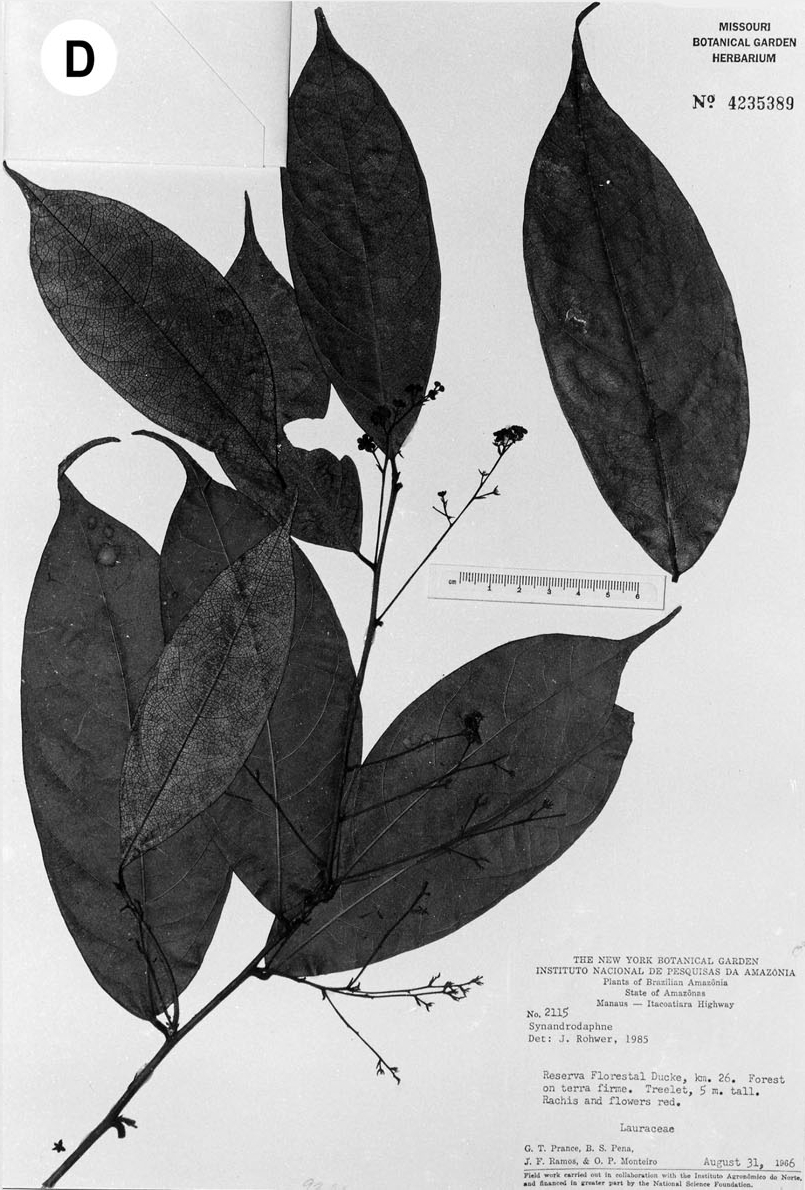
Type. Brazil. Amazonas: Mun. Manaus, Ducke Forest Reserve, 31 Aug 1986 (stam. fl), Prance, Pena, Ramos & Monteiro 2115 (holotype, MO; isotype K).
Cupula crenata insignis; quoad characteres vegetativos Endlicheriae sprucei accedens sed foliis supra haud nitidis, infra pubescentibus et staminibus quadrilocellatis differt.
The epithet refers to the strongly lobed cupule with rounded, woody persistent tepals. [Lat. crenatus, with rounded teeth + cupula, cup].
Local names. Brazil: louro branco, louro preto.
Description
Shrubs to trees: branches basitonic, in axils of cataphylls; twigs terete, 1–2 mm diam.; epidermis brownish; terminal bud plump, ca. 3 X 1 mm; cataphylls persisting on current flush, up to 4 mm long; indument pubescent, caducous after one flush, the hairs sparse, up to 0.5 mm long, straight to curved, erect, brownish. Leaves: petioles pulvinate, 0.3–1 cm X 1–1.8 mm, terete; blades chartaceous, flat, narrowly to broadly elliptic, 6–18(–22) X 2–9 cm; base obtuse, 50–120°; apex obtuse, 60–80°, ultimately acuminate for up to 2.5 cm; margin plane; primary vein above and below raised; secondary veins 6–7 pairs, equidistant, brochidodromous, above slightly raised, below raised, diverging at ca. 60°, evenly arching, chordal angle 25–30°, the angle uniform along blade length; tertiary veins above inconspicuous, below slightly raised, random-reticulate to scalariform; higher order veins above inconspicuous, below slightly raised; surface above light green to bluish-green, below olive-green to greenish-brown, the veins yellowish; indument above absent, the primary vein tomentose, below pubescent, the hairs isolated, up to 0.5 mm long, straight, erect, yellowish to yellowish-brown, denser on the veins, persisting for at least two flushes. Staminate inflorescences: basitonic, erect, peduncles 2–12 cm long, the hypopodia 1–5 cm X 0.5–1 mm, branch orders 3, the second-order branches 5–7, dispersed, lowest branch up to 1.5 cm long, color and indument of all axes as on twigs; bracts caducous, up to 4 mm long, adaxially hairy (glabrous); bracteoles persistent, up to 1 mm long, adaxially hairy (glabrous). Staminate flowers: pedicels ca. 4 X 0.6 mm, the diameter even throughout; receptacle obconical, ca. 1.6 X 2.5 mm; tepals membranaceous, obovate, ca. 3.2 X 2.5 mm (inner whorl slightly smaller), at anthesis spreading, yellowish-brown, translucent, adaxially puberulous; stamens of whorls I and II minutely spathulate to lacking a distinct filament, the anthers broadly elliptical, ca. 1.2 X 1.4 mm, glabrous, the locelli 4, apical, in a shallow arch, introrse, the glands absent; whorl III columnar, ca. 1.2 X 1 mm, with a few hairs at base, the locelli 4, the upper pair latrorse, the lower pair extrorse, the glands globular, ca. 0.5 mm diam.; whorl IV absent; all stamens reddish; pistillode filiform, ca. 0.5 X 0.4 mm, basally hairy. Pistillate flowers: pistil ca. 2 X 1 mm; ovary globose, ca. 1.2 mm long, hairy. Fruits: pedicels up to 10 X 3 mm, abruptly enlarging to form the cupule; cupule hemispherical, up to 5 X 12 mm, smooth, the margin undulate, tepals persisting; berry elliptic, up to 22 X 13 mm.
Field notes
Shrubs to trees up to 6(–8) m tall and 5 cm diam., already flowering when 1 m tall; outer bark smooth?, dark brown; inner bark ca. 3 mm thick, salmon red; wood creamy yellow. Inflorescence axes red; tepals red. Cupule red.
Distribution (Figure 13)
Most specimens are from the vicinity of Manaus, in central Brazilian Amazonia, but three specimens from the upper Jurua and Purus rivers (southwest of Manaus), one from the mid–Rio Negro, and four from the department of Loreto in Peru indicate that this species may be more widespread in the Amazon Basin. It grows on various soil types in non-inundated rain forest at 25–100 m elev. (up to 300 m in Peru). Flowering begins in June, concurrent with the onset of the dry season, and lasts until September. The fruits are found ripe October–January, during the rainy months.
Additional specimens examined
Peru. Loreto: Maynas, Iquitos, near Lago Zúngaro, 22 Oct 1964 (fr), Dodson 2850 (MO, US); Requena, Jenaro Herrera, Río Ucayali, 27 Jun 1986 (pist. fl, fr), R. Vásquez et al. 7689 (MO X2); Requena, Jenaro Herrera, Sapuena, 14 Sep 1987 (fr), R. Vásquez & N. Jaramillo 9564 (MO). Ucayali: Aguaytía, 18 Oct 1972 (fr), Schunke-V. 5406 (F, NY).
Brazil. Amazonas: Mun. Manaus, Reserve 1501, 21 Nov 1988 (fr), Boom et al. 8572 (MO); Manaus-Caracarai rd., Km 97, 3 Sep 1979 (stam. fl), Cid et al. 981 (MO); Mun. Manaus, edge of Igarapé de Passarinho, 25 Jul 1956 (stam. fl), D. F. Coêlho (INPA) 3990 (NY); Mun. Manaus, BR 17, Km 9, 1 Aug 1956 (stam. fl), D. F. Coêlho (INPA) 4025 (NY); Mun. Manaus, Reserve 3402, 25 Feb 1992 (fr), Dick 6 (US); basin of Rio Jurua, near mouth of Rio Embira, 30 Jun 1933 (stam. fl bud), Krukoff 5098 (BM, F, K, NY X2, US); Mun. Manaus, Fazenda Dimona, 27 Nov 1989 (fr), Kukle 123 (MO, NY); Mun. Manaus, Reserve 1501, 11 Nov 1988 (fr), Mori & Fernandez-da-Silva 19744 (MO, NY); Mun. Manaus, Fazenda Dimona, 12 Feb 1992 (fr), Nee 42516 (NY); Manaus-Aleixo rd., 30 Aug 1973 (stam. fl), Prance et al. 18761-B (MO); Manaus-Caracarai rd., Km 28, 10 Nov 1966 (fr), Prance et al. 3047 (NY); Manaus-Manacapuru rd., Km 25, 3 Jan 1967 (fr), Prance et al. 3886 (NY, US); Mun. Manaus, Tarumã rd., 1 Oct 1967 (fr), Prance et al. 3919 (NY X2); basin of Rio Purus, 3 km SW of Lábrea, 28 Oct 1968 (fr), Prance et al. 7993 (NY); Manaus-Pôrto Velho rd., Km 246, 4 km S of Igapó Açu, 14 Mar 1974 (fr), Prance et al. 20525 (NY); Manaus-Caracarai rd., Km 60, INPA Experimental Reserve, 30 Aug 1974 (stam. fl), Prance et al. 21690 (MO); Manaus-Caracarai rd., Km 64, 18 May 1984 (stam. fl bud), Renner 991 (US); Mun. Manaus, Ducke Forest Reserve, 30 Jun 1993 (pist. fl), Ribeiro et al. 943 (INPA, MO); 4 Jul 1993 (stam. fl), 1003 (INPA, MO); Upper Rio Negro, Ilha das Flores, 14 Jan 1960 (fr), Rodrigues & L. Coêlho 1469 (NY); Manaus-Itacoatiara rd., Km 70, 11 Nov 1960 (fr), Rodrigues 1911 (NY); Manaus-Itacoatiara rd., Km 80, 9 Jun 1961 (st), 2752 (NY); Mun. Manaus, Ducke Forest Reserve, 17 Jul 1963 (stam. fl bud), Rodrigues 5369 (F, NY X2); Manaus-Porto Velho rd., 14 Jul 1972 (stam. fl), M. Silva et al. 744 (MO); Manaus-Caracarai rd., Km 40, 10 Dec 1973 (fr), Steward & Ramos P.20098 (MO); (stam. fl), P.20100 (MO); Manaus-Caracarai rd., Km 127 (fr), Steward et al. P.20308 (MO). Roraima: Serrinha, Rio Mucajaí, 31 Jan 1967 (fr), Prance et al. 4211 (NY).
Discussion
Rhodostemonodaphne crenaticupula is easily recognizable by its tepals which are deep red at anthesis and persist in fruit as conspicuous, rounded, woody projections. The dry leaves have a dark lamina that contrasts with the light venation.
Vegetatively this species can easily be confused with Endlicheria sprucei (Meissner) Mez, which has an overlapping range. Both species have slender twigs with similar indumentum, and leaves similar in shape and size. Nevertheless, at least when dry, the adaxial leaf surface of E. sprucei is conspicuously smooth and shiny, while that of R. crenaticupula has a raised venation, and is dull.