Description
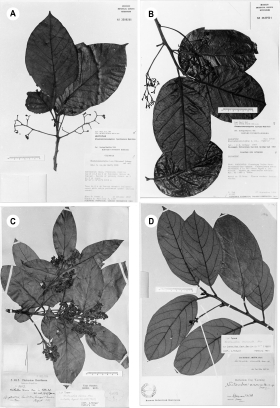
Dioecious trees, shrubs or scandent shrubs:branches basitonic to mesotonic, in axils of cataphylls or foliage leaves, scattered (pseudo-verticillate); twigs terete (angular); indument present (or absent), persisting to soon falling; terminal buds plump or slender; cataphylls caducous (or persisting). Leaves spiral, with 2/5 phyllotaxis; petioles robust, slender, or pulvinate, adaxially flattened or terete; blades coriaceous to chartaceous, flat, undulate to bullate; outline elliptic, ovate, obovate to oblong; base rounded, obtuse, acute, cuneate to cordate (decurrent); apex rounded, obtuse, acute to attenuate, acuminate or mucronate; margin plane to revolute; secondary veins eucamptodromous (brochidodromous), (forked); tertiary veins random-reticulate or scalariform; indument present or absent, persisting to soon falling. Staminate inflorescences: basitonic, mesotonic, acrotonic, or along whole length of flush, pendulous or erect, spicate with up to 2 branch orders to lax, thyrsoid with 5(–8) branch orders, the branches scattered (clustered apically); bracts and bracteoles caducous or persistent, adaxially hairy or glabrous. Staminate flowers: pedicel diameter even throughout to increasing apically; receptacle obconical to flat, or globose (constricted at place of tepal inception); tepals coriaceous, chartaceous to membranaceous, elliptic, ovate, obovate to oblong, the outer and inner ones mostly equal, erect, spreading to recurved, hairy or glabrous (papillose); stamens of whorls I & II, spathulate, capitate, filiform (loriform), or anthers sessile, thickened or laminar, the two whorls mostly equal, glabrous to puberulous (papillose); anthers mostly 4-locellate, but 2- or 3-locellate ones present; locelli apical in a shallow arch to nearly bijugate, introrse or the lower pair latrorse; glands mostly absent; whorl III columnar, capitate or filiform (loriform); anthers mostly 4-locellate, but 2- or 3-locellate ones present; the upper locelli mostly latrorse and lower ones extrorse or all locelli extrorse (introrse); glands mostly present, globular or variously fused in a ring; whorl IV mostly absent or staminodial; pistillode present or absent. Pistillate inflorescences: similar to the staminate ones, but often with fewer branch orders and flowers. Pistillate flowers:ovary filiform to ovoid, or globose, mostly glabrous. Fruits:pedicels gradually to abruptly enlarging to form the cupule; cupule hemispherical to trumpet-shaped (rarely reflexed), smooth, wrinkled, or tuberculate; margin with truncate to deep lobes, undulate, or straight; tepals persisting or caducous; berry elliptic (ovoid).